Showing posts with label Humanism. Show all posts

Thursday, June 20, 2013

Gov. Rick Perry: "Religious Freedom Does Not Mean Freedom From Religion.”


Many of us are familiar with the supposed “war on Christmas” narrative that is propagated by theligious right as most notably put forward by those such as Bill O’Reilly, Rick Perry and Sarah Palin. However, this narrative is but a surface manifestation of a deeper dialogue that Christianity, and Christians are under attack in America. They are under attack by secularism, by liberals, by the LGBTQ community, by atheists, by nonbelievers, by those that seek to create and flourish in a truly pluralistic and multicultural civil society. A few keys issues in this diatribe can be thought of as prayer in public schools, protecting the LGBTQ community from discrimination, taking the word God off our currency and out of the Pledge of Allegiance, not allowing nativity scenes to be placed on public property and so on and so forth. Whatever side of the argument we as individuals may align; we are all, to some extent, familiar with this dialogue however superficially I just presented it.

This past week, on June 13th 2013, Governor Rick Perry thought it necessary to sign into law the “Merry Christmas Bill”. Perry said, "People of faith too often feel they can't express their faith publicly. And if they dare display it, they find themselves under attack from individuals and organizations that have nothing to do with them or their communities for that matter."[1] This law, which goes into effect this coming September, is designed to allow religious displays in schools as long as there is more than one religion being represented or if a secular symbol is present. Whether or not this bill is necessary or appropriate is another question. The much more prevalent issue is that Rick Perry, when introducing this bill, said, “Religious freedom does not mean freedom from religion.” This is a heavy statement that requires a bit of unpacking.


Perry’s remarks reflect a fundamental misunderstanding of human rights and what freedom and religion actually means. A distinction I always find myself making when discussing these issues is that of freedom of religion and freedom of conscience. Could you tell me, off hand, what the difference between the two is? It’s actually quite difficult and requires defining the terms. What do we mean when we say freedom of religion? What does religion actually mean here? Would it be appropriate to say it includes the freedom to find meaning, purpose and joy in our lives? If so, religious organizations, tradition and dogma can become irrelevant to leading a “religious” life. Indeed, many people, especially in the past few decades are choosing to shed religious tradition and myth in favor of something more personally fulfilling whether it be a “spiritual but not religious” orientation, or identifying as a humanist or atheist or nonbeliever. This is not new information. I feel that religion is often used in an unfortunately narrow light. I often ask: “what is more religious than your conscience?” What is more religious than critical thinking? What is more religious than following your reason as far as it can take you? Whether someone is a believer or a nonbeliever, having freedom of conscience is the essence of freedom of religion.

Religious freedom is a narrow term and usually comes with narrow understanding. I prefer the term freedom of conscience as it necessary includes alternative and broader ways of understand religion as a mechanism for finding truth, meaning and purpose. Governor Rick Perry is a victim to a false dichotomy. He is a religious zealot fighting for his team against a false enemy. At the basest level, this man is limiting the religious freedom he is trying so desperately to protect. “Freedom of religion does not protect freedom from religion” is an oxymoron. Freedom of religion necessarily includes freedom from religion. This is correctly understood by many as a fundamental human right. For example, the U.S. Commission on International Religious Freedom (USCIRF) published an op-ed this past January entitled “Government Must Protect Nonbelievers.” In this essay Katrina Lantos Swett the Chair of USCIRF and Dr. M. Zuhdi Jasser, a Commissioner of USCIRF, say

While religious freedom is an integral part of our heritage, it also is misunderstood. A key misunderstanding concerns the matter of belief. Simply stated, religious freedom means not only the right to believe, but the freedom to disbelieve — to embrace any religion and to reject every religion. People express their religious freedom by choosing theism, atheism or any other response to ultimate questions. Religious freedom allows them to follow wherever their conscience leads.[2]

Secretary of State John Kerry echoed these remarks this past May. He said,

“Whether it be a single deity, or multiple deities, or no deities at all, freedom to believe —including the freedom not to believe — is a universal human right…But freedom of religion is not an American invention. It’s a universal value. And it’s enshrined in our Constitution and ingrained in every human heart. The freedom to profess and practice one’s faith, to believe or not to believe, or to change one’s beliefs, that is a birthright of every human being.”[3]

Whether it’s Jon Stewart calling it “Bullshit Mountain” or Bill Maher calling it “The Bubble,” Governor Rick Perry certainly lives there. Nonbelievers and secularists, including religious secularists, are continuing to be persecuted for their efforts to create a pluralistic society that protects all people from discrimination. As history has shown the most dangerous forms of discrimination are those that come with the justification of religious dogma and righteousness. Governor Rick Perry’s ignorance and intolerance of human rights and freedom of conscience is a stain upon public policy and a hindrance to the evolution of civil society.


[1] http://www.huffingtonpost.com/2013/06/14/rick-perry-freedom-from-religion_n_3441187.html?ir=Religion&ncid=edlinkusaolp00000008
[2] http://www.uscirf.gov/news-room/whats-new-at-uscirf/3918-op-ed-richomnd-times-government-should-protect-nonbelievers-january-22-2013.html
[3] http://occupydemocrats.com/secretary-of-state-john-kerry-freedom-not-to-believe-is-a-universal-human-right/

Tuesday, September 11, 2012

Meditations for the Humanist - Part 2 - Tolerance and DOMA


“The peak of tolerance is most readily achieved by those who are not burdened with convictions.” – Alexander Chase

An intolerant person is defined as one who “wishes others to live as the thinks they ought, and who seeks to impose his practices and beliefs upon them” (Grayling 2002, 7) True tolerance states that humanity thrives most by “permitting a variety of lifestyles to flourish, because they represent experiments from which might be learned about how to deal with the human condition” (Grayling 2002, 7-8).  Democracy has a similar aim in that a government run by the people, for the people, must include the voices and active participation of all demographics for it to flourish, especially if it is to afford the protect of minority rights. There is an inherent danger in democratic style government, namely majority oppression of minorities.

Grayling says,
Tolerance is, however, not only the centerpiece but the paradox of liberalism. For liberalism enjoins tolerance of opposing viewpoints, and allows them to have their say, leaving it to the democracy of ideas to decide which shall prevail. The result is to often the death of toleration itself, because those who live by hard principles and uncompromising views in political, moral and religious respects always, if given half a chance, silence liberals because liberalism, by its nature, threatens the hegemony they wish to impose.
Foreseeing this danger, the founders blessed us with the Bill of Rights as well as checks and balances in government. This was done in order to protect all citizens, especially minority demographics from majority oppression, including religious oppression.

The traditional republican platform has always had a foundation in states rights and a smaller federal government. The power of the federal government was seen as a threat to personal liberty.  However, when it comes to civil liberties and human rights issues, puritan morality seems to trump this age-old Republican value. This is becoming quite relevant with various contemporary social issues, especially homosexuality, marriage and the DOMA (Defense of Marriage Act). 

Traditionally marriage has been a religious ceremony, and many prefer it to remain as such. However, in this country, in this secular country, marriage is a civil right. Vermont, Connecticut and New York, which all have legalized gay marriage, now content that DOMA is a violation of states rights. They contend that the federal government has not right or authority to regulate the institution of marriage. The civil rights granted by marriage simple have nothing to do with religion, such as social security benefits, child-care tax credits, family and medical leave to take care of loved ones and COBRA health care for spouses and children. By denying a citizen these civil rights, they are thereby being denied human rights. The fourteenth Amendment to the Constitutions provides all citizens equal protection under the law. The Universal Declaration of Human Rights also speaks to this issue in its first, second and seventh articles, which says “All are equal before the law and are entitled without any discrimination to equal protection of the law…”

DOMA is designed to prevent the legalization of same-sex marriage at the state level. The LGBTQ community is being discriminated against as they are denied this equal protection. They are being denied their civil/human rights. Once more, they are being denied this right from the Republican Party that supposedly champions personal freedom and liberty and views the Federal government as intrusive and oppressive. This is a fabulous example of how the Republican platform has lost its way. It is no longer centered around small government and states rights, but it has been hijacked by moralistic, intolerant religious fanatics who at their very core are opposed to the liberalism, pluralism and democratic ideals that America is founded upon.

I am not saying that marriage cannot be a religious ceremony. What I am saying is that in a democratic, pluralistic society, those who do not wish to be religious, those who do not want religion to have any part of their civil/human rights, shouldn’t be denied their rights because it makes religious people uncomfortable.

By providing the same rights to all citizens, society will thrive and become more cohesive and functional. Chris Kluwe, the punter for the Minnesota Vikings said, “You know what having these rights will make gays? Full-fledged American citizens just like everyone else, with the freedom to pursue happiness and all that entails. Do the civil-rights struggles of the past 200 years mean absolutely nothing…?” Chuck Norris recently said a thousand years of darkness will not ensue. And many prominent figures who claim that hurricanes and other natural disasters are Gods punishment for sanctioning equality are intolerant religious bigots who should not be tolerated, let alone be given a platform to spew their fear. Intolerance itself is merely a symptom of fear and insecurity. And this is what the Republican Party has become in my eyes, a political party based on intolerance rooted in fear and insecurity. The relevant question is….”Should the tolerant tolerate the intolerant?” And the answer is obviously no. Tolerance must protect itself. No one can force another to adopt a certain viewpoint or practice. The only coercion should be argument and honest reasoning, which is what we would expect from our government. Religious freedom does not entail the right to discriminate. Protecting minorities and civil rights is not an attack on Christianity. It is compassionate. It is based in identification with all of humanity, regardless of creed, sex, color of skin and any other label. It is based in ethics, an ethics encouraged not by religious discourse, but by secular discourse, which provides and equal footing for all. For a deeper in depth discussion please see my previous post “Tolerating the Intolerant.”

http://www.npr.org/blogs/thetwo-way/2012/09/09/160840674/states-rights-and-doma-clash-on-a-shifting-battlefield?ft=1&f=1001

Grayling, A.C. (2002). Meditations for the Humanist: Ethics for a Secular Age. Oxford: Oxford University Press.

Monday, September 10, 2012

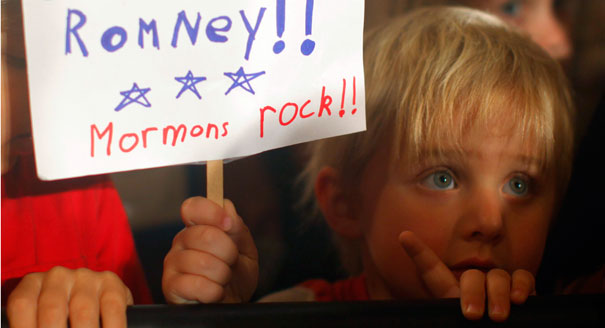
Romney's So-Called Religious Freedom


Mitt Romney said, “Freedom requires religion just as religion requires freedom. Freedom opens the windows of the soul so that man can discover his most profound beliefs and commune with God. Freedom and religion endure together, or perish alone…

“We are a nation under God, and in God we do indeed trust. We should acknowledge the Creator, as sis the founders, in ceremony and word. He should remain on our currency, in the Pledge, and in the teaching of our history.” He delivered this speech at the George Herbert Walker Bush Presidential Library, in Texas.

I wonder what the nonreligious nations of Europe would have to say about this. Especially since those nations with the less religious affiliation and influence are also happier according to their gross national happiness index. And why is it that the more religious nations tend to be less free and are less happy?


Are non-Mormons, non-Christians and non-theists still Americans under the vision Mitt Romney has for America? And what kind of America is Mitt Romney envisioning? What kind of freedom does his religion create and allow? He speaks of freedom and religious liberty, of family values and moral vision. Yet he would cut all funding for Planned Parenthood because a fraction of their public health services include providing abortions, and even when they use no public funding for those abortions. He wants to enact a federal law that would ban gay marriage. Yet this is in no way attached to his Mormon beliefs right? He speaks of “moral pollution.” He says he is “concerned with the drug culture, the pornography, the violence, sex and perversion.” He says every computer sold in the future should block all pornography. He says he wants to enforce obscenity laws. This is ironic considering that multiple studies have shown that “conservative religious type, especially Mormons, are more likely to use porn.” – Adam Greenwood (March 2, 2009).

Mitt Romney lives in his religious bubble. He will make public policy decisions based on his limited and exclusivist idea of morality and social order. It was not long ago that George Bush Sr. said, “I don’t know that atheists should be regarded as citizens, or should they be regarded as patriotic. This is one nation under God.” Those with no religious affiliation, whether atheist, non-theist or agnostic, represent 19% of the American population.  It’s time to get religion out of politics. Its time to take religion completely out of the public sphere. It’s time for nonbelievers to come out of the closet! It’s time to acknowledge and celebrate our secular heritage, our pluralistic heritage. It’s time for those with so called religious values to stop pushing their views onto other people. It’s time for a secular ethics that encourages dialog and conversation to take the place of misguided and outdated moral certainty.

http://www.patheos.com/blogs/lovejoyfeminism/2012/08/mitt-romney-will-put-an-end-to-porn-somehow.html

Friday, September 7, 2012

Agnostic Buddhism - Buddhism Without Beliefs


Stephen Batchelor, in his book Buddhism Without Beliefs, describes an agnostic Buddhism. He does not describe Buddhism as a religion per se but as a method. Buddhism, he says, is not so much something to believe in, but is something to do. It is an activity, a lifestyle and a practice that we can integrate into every aspect of our experience. To be a Buddhist, do you have to be someone who believes certain propositions such as the four noble truths or reincarnation? According to Batchelor, the answer is no. He says Buddhism is not particularly religious or spiritual in the usual ways we understand these terms. It is simply a way to be in the world. Rather than being focused on deities, beliefs and supernatural claims, Batchelor claims Buddhism is founded in the agnostic tradition.

T.H. Huxley first coined agnosticism in 1869. He explained it as a method “realized through the ‘rigorous application of a single principle.’” This principle has both positive and negative aspects. The positive aspect exclaims, “Follow your reason as far as it will take you.” The negative aspect asserts that one should “not pretend that conclusions are certain which are not demonstrated or demonstrable. “ An agnostic Buddhist would not regard Buddhism as a source of answers to questions of where we came from, where we are going or what happens after death. Batchelor says an agnostic Buddhist would seek knowledge in the appropriate domains such as science. As for supernatural claims and questions about the origin of the universe or what happens after death, the Buddha himself remained silent. These questions were seen as distractions, as irrelevant to our human condition, irrelevant to the reality of suffering.

Buddhism however can become a dogmatic system when we elevate the matter of fact-ness of the four noble truths to holiness. They can become propositions to believe in. (Western scholars even superimposed the term Buddhism. This label allowed Buddhism to become a creed, which could be then compared to other creeds around the world. It can be easy to reduce a tradition and a religion such as Buddhism to a list of beliefs and practices that obscures its agnostic heritage and complexity.) Supernatural questions are seen as mysteries, not problems with answers that can be solved through meditation or prayer or through belief in a set of doctrine. Arbitrary answers to supernatural questions that are not demonstrated or demonstrable are simply irrelevant.  Strategies such as prayer and beliefs in doctrine merely replace mystery with beliefs in an answer that are often clinged to with such fervor that they distract from true ethical conversation and can even cause a great deal suffering, hatred and divisiveness.

Batchelor makes an important distinction between existential confrontation and existential consolation. Most of what we understand as religion can be seen as consisting of condolatory elements such as assurances of a better afterlife. Buddhist practice can be said to start not with belief in a transcendent reality but through embracing the “anguish experience in an uncertain world.” This is the essence of the first noble truth. We must have the courage to face whatever life throws at us without recourse to supernatural claims or consolations. To accept whatever comes with equanimity, and the humility to learn from every situation. Agnosticism shifts concern away from the future life and supernatural dialogue and brings it back to the present moment. Agnosticism is not passive. Instead, it is a dialogue, an ongoing encounter and existential confrontation with the unknown and mystery of our existence. Buddhism in this way, Batchelor says, might have “more in common with godless secularism than with the bastions of [western] religion.”

We must also make a distinction between ethics and morals, or more specifically ethical integrity as being distinct from moral certainty. A priori certainty about right and wrong is simply at odds with a changing and unreliable world. An ethical question should not be framed as ‘what is the right thing to do?” but “what is the compassionate thing to do?” This question can be approached with integrity but not with certainty. Likewise, agnostic Buddhism demands ethical conversation rather than moral claims based in supernatural hope and fear. This dialogue inevitably forces an encounter with our moral conditioning, which is based largely in psychological and social habit. We tend repeat the gestures of parents, authority figures, or religious texts. And while this sort of moral conditioning may arguably contribute to some aspect of social stability, it is nonetheless inadequate as a paradigm of ethical integrity. Encountering our socialized norms of morality, ethics, and supernatural claims and assumptions is precisely the type of encounter that agnosticism and Buddhism seek out. It is a creative and ongoing process that can be said to be the very basis of a genuine religious lifestyle, of genuine ethical conversation, both as individuals and collectively. Moral certainty based in supernatural claims that are not demonstrated or demonstrable, also inevitably lead to fantasies of moral superiority. As Batchelor said, “Instead of creatively participating in a contemporary culture of awakening, we confine ourselves to preserving those cultures of a vanishing past…we repeat the clichés and dogmas of other epochs.” We have seen many times how fantasies of moral certainty do not foster compassion or ethical dialogue, but usually result in arrogant, elitist and confrontational perspectives.

Our definition of religion itself is being challenged and expanded. Publishers Weekly, in reviewing Batchelor’s book said, “Buddhism is not strictly a religion, since it does not adhere to a belief in God; that the Buddha did not consider himself a mystic or savior, but a healer; and that Buddhism is less a ‘belief system’ than a personal ‘course of action’ that naturally instills morality, compassion, and inner peace in the practitioner.” The problem with this quote however is that it equates religion with theism and having a belief system. Buddhism is better said to be a nontheistic religion. After all, a tradition can be a religion even if it does not believe in a God or gods or have supernatural beliefs. Buddhism instead, can be thought of as a method. It is continuously evolving and adapting to the needs of the human condition without recourse to supernatural claims and without belief in a god or deities. Agnostic Buddhism is at its core, a confrontation and dialogue with our human condition. For further elaboration on the definition and understanding of evolving religion, see my previous post on Ken Wilber. 

Batchelor, Stephen. (2008). Buddhism Withouth Beliefs: A Contemporary Guide to Awakening. Riverhead Trade.

Thursday, September 6, 2012

Meditations for the Humanist – Part 1 – Moralism

Oscar Wilde famously said, “a man who moralizes is usually a hypocrite.” According to A. C. Grayling, a moralizer is a “person who seeks to impose upon others his [or her] view of how they should live and behave.” It reflects a coercive and exclusive worldview that is inherently opposed to democratic and pluralistic ideals.

Moralizers want others to conform to their views. They do this through coercive measures such as social disapproval as well as their more preferred option: legal controls. You can see this reflected in our nations history with blasphemy laws as well as more contemporary, hot button, issues such as gay marriage, abortion, religious symbols and text in public areas and prayer in public schools. 

Attacks on liberal policies such as these are expressions of hostility towards lifestyles moralizers personally dislike. Their hostility is brought into the public sphere, often through declarations of religious freedom, and manifest aspects of insensitivity, intolerance, ignorance of alternative interests and needs in the human experience and arrogance in believing there is only one acceptable way of living. They claim to have a “monopoly on moral judgment.’” We can recognize the familiar rhetoric of those claiming to defend the “traditionalist fantasy of ‘family morality’”. But the true attitude underneath moralizers is fear. The moralizer fears policies and practices that allow and encourage diversity in lifestyle and the freedom of choice.

Justification for their rigidly and arrogance comes from so-called religious doctrine and values. This is a pure reflection of exclusivist religion, which I’ve spoken about plenty in previous posts. This fear and its effects are inherently anti-pluralistic and anti-democratic. Diversity of thought is not allowed or encouraged. The demand conformity to lifestyles they see as personally acceptable. The external world, others, must conform to their internal preferences. Compromise is shunned and viewed as weakness. Their religious anxieties compel them to prevent the rest of society from “thinking, seeing or doing what they are afraid to think, see or do themselves.”

Secularism has become the enemy. Atheists and humanists alike are seen as being deviant and unworthy of any serious dialogue. Christianity is seen as being under attack. But secularism, in actuality, does not attack religion just like an umbrella does not attack rain. It provides a platform and foundation for diversity of thought, conscience and lifestyle. It protects all citizens’ right to have equal protection under the law, to have equal opportunity, voice and representation. Secularism encourages an ongoing, ever-evolving, creative process in public policy and societal norms. It sees culture and values as something malleable and dynamic, not fixed and rigid. And most of all, secularism, is not coercive or exclusive. All have a place at the table. Unfortunately, it also allows for the voice of the intolerant and the fearful (See “Tolerating the Intolerant” post).

Grayling, A. C. (2002). Meditation for the Humanist: Ethics for a Secular Age. Oxford: Oxford University Press. 

Tuesday, July 24, 2012

"In God We Teach"

The newly released documentary “In God We Teach” follows the story of Mattew LaClair, a high school student in Kearney, New Jersey. LaClair brought forth allegations of his high school history teacher, David Paszkiewicz preaching Christianity in the classroom. This documentary examines this case and its underpinning issues in just over an hour. I highly recommend you watch the entire film. However, if you would like to skip around and see just the highlights if have a few key moments referenced.

21:50 - 23:00: Paszkiewicz likens Christianity to having the cure for cancer. If you have the truth, why would you keep it from other people?

26:00: Paszkiewicz says, "there are a lot of lost people out there. If they are unreached, the consequences could be terrible"

29:00: Is the younger generation as aware as older generations of issues around separation of church and state?

31:30 - 34:00: Academic freedom is discussed.

34:42: Paszkiewicz says, "Teaching Darwinism is something thats going to take poeple's eyes off of God, especially Jesus Christ."

37:30: Paszkiewicz says, "and it may be against the law to teach creationism as fact but that doesn't mean its wrong."

In addition to being a youth pastor, Paszkiewicz also leads Christian Club Meetings for youth. At these meetings he attempts to disprove evolution and the big bang. This is something that has always rubbed me the wrong way. Regardless of my personal opinions about religion and its constant denial and suppression of science in fundamentalist followings, religion and science, especially religion and evolution are not mutually exclusive. There are certain folks, that would like to be seen as representative of religion, who draw this distinction. They do not represent religion, and they certainly are not representative of Christianity as a whole. That being said, evolution is not, and should not be associated with atheism. It is nontheistic. It is science. Nothing more. If this disproves any aspect of religious thought, then that religious thought must adapt, change or be destroyed. It is no longer representative of our current knowledge about the world and our relationship to it.

42:15: Paszkiewicz says, "I don't believe that my religious beliefs trump the constitution but I do believe that the word of god does."

42:00 - 44:00: Paszkiewicz says, "Religious neutrality is one thing but hostility to Christianity is quite another, and what I find is that this neutrality often means the exclusion from Christianity in the public square."

There is to often the argument that there is a war against Christianity in this country, or a war against Christmas. This is all complete nonsense. If the government does not support a certain view of Christianity or any religion, it is automatically seen as being hostile to that view/religion. The government is a secular institution. It is meant to be free of competing religious ideas as these are the most virulent competitions.

46:00: Paszkiewicz says, "We take god out of the equation, in time, i fear what kind of government we could have."

46:30: Paszkiewicz says, "I do think we ought to be unified around a set of values that are essentially Judeo-Christian"

48:00: Paszkiewicz "I don't see the danger in promoting, lets say the 10 commandments, how can things like 'thou shalt not kill' be psychologically damaging to a student?"

It is so easy for a supporter of the ten commandments to cite the “thou shalt not kill’ commandment as evidence that all ten should be accepted and taught. It neglects to mention the majority of the other nine. Why is this? Maybe its because “thou shalt have no other gods before me” or “do not take the lords name in vain” or “on the seventh day the lord rested” have absolutely no place in civil society, let alone its governance.

A year after this incident Paszkiewicz formed a student “Alpha and Omega Club.” This club was planning a trip to the creation museum in Kentucky. The “educational rationale,” for the trip was that: "students will be exposed to the science behind creationism."

This is a great documentary. I highly recommend it. If anything else it’s a great introduction into the multifaceted debate on the separation of church and state, prayer and other religious ceremonies or ideas in public schools, the so-called evolutionism/creationism debate and the growth of the nonbeliever population in the United States and what its effect could be on combating the religious right and the organization of “nones” as a political demographic. The link for the documentary is here: http://ht.ly/cndug 

Thursday, July 12, 2012

Humanism 101


Bam. This is the newly updated manifesto of humanistic philosophy. A few things really stand out for me. In the opening statement, it says explicitly "without supernaturalism". This may bother some people, both religiously inclined and perhaps those who would prefer the label of spiritual. Fact of the matter is, supernaturalism has no bearing whatsoever in the collective interest of society in terms of building a cohesive and ethical system in which to live. If you disagree, please argue your case. 

Humanism aspires "to the greater good of humanity". This naturally curtains any racist, sexist or other form of discrimination based on human circumstance. Religion, as well all know, is the best at excluding others based on circumstance, whether its based on skin color, gender, sex, nationality, a different idea and symbol of the divine, or even just a different name for the same or damn near similar idea of God. The in-group/out-group dynamic has no place in humanism and it does everything in its power, from the very foundation of its ethical system, even down to its name and label, to avoid any possibility of discrimination on circumstance. 

This obviously is something we can spend a lot of time talking about and dissecting. But for newbies to humanism who constantly ask me "What's that?" or "What did you say you were?" Here is your answer. Humanism 101. 

Thursday, June 28, 2012

"Out of Many, One"

"Out of Many, One"


Do you agree with the assertion that "In God We Trust" both on our currency and as the de facto U.S. motto and that "Under God" in the Pledge of Allegiance was a 1950s fear response to communism? Was it an attempt at solidarity that happened to use federally sanctioned religious language? Or was it something else? Thoughts?

Nonetheless, it's a civic history lesson. Most people do not know that this religious language was not around until the 1950s. Using them as some sort of tangible example of our Christian or Deist religious heritage is completely unfounded. I personally like "Out of Many, One." This speaks more to the inherent pluralistic intent and reality of this country and of the world. And unlike "In God we Trust", or "Under God", it does not discriminate against nonbelievers, secularists, atheists, nontheists and the like.

Monday, June 11, 2012

American Humanist Association President David Niose


I was privileged to attend this years American Humanist Association (AHA) conference in New Orleans. During this conference the President of AHA, David Niose, gave a short talk about his new book Nonbeliever Nation: The Rise of Secular Americans. His talk was very inspirational. I would like to briefly outline some of his main points.

Niose described humanism as not just a movement, but a movement that is a response to the threat and rise of the religious right. He focused on three main themes:
1.     How the religious right has decimated this country and how many are simply unaware of how many problems are directly attributable to the religious right.
2.     Why the opposition to the religious right has been so unsuccessful and ineffective.
3.     How the modern secular movement is providing a successful opposition that if successful, could revert the religious right’s influence back to pre-Reagan levels.

Niose spoke about the infamous “culture wars” that continue to rage. Many on the religious right and even religious moderates still claim and exalt America’s rich religious heritage. They use this as a means to justify Christian predominance and influence in the public square. This, according to Niose, has created a mythology. And this mythology glosses over some terrible truths that seem to have been forgotten.

Many of our initial founders in the new world, namely pilgrims and puritans, actually despised religious pluralism and freedom. They first left England for Holland and then left Holland specifically because it was to open a society for their taste. They came to the new world in order to establish a theocracy. We seem to forget that they would hang Quakers and other Christian denominations simply because they challenged their exclusive claim to truth. And of course let us not forget the Salem Witch Trials, motivated by religious Puritanism.

Many often refer to the great religious revivals in American history. But are these revivals anything to be proud of? The apocalyptic visions they espoused still permeate our religious and unfortunately political discourse to this day (albeit more covert). And of course, they were all infused with an anti-Catholic bigotry.

Niose simply asks us to compare our religious heritage to our secular heritage. Is there anything to be ashamed of in our secular heritage? Our secular heritage was based on the values of the enlightenment. It was based on science and reason. For the first time ever, some people, in some places, under certain circumstances could actually reject Christianity openly without any repercussions. This heritage, more often than not, is never acknowledged. There is nothing in our secular history that is embarrassing, nothing we need to sweep under the rug. Rather, it is something to be proud of. Pop culture has embraced this heritage, has embraced skepticism to a degree. Yet this acknowledgement, Niose says, ends with politics. Seven states (Texas, Maryland, Tennessee, Mississippi, South Carolina, Arkansas and Pennsylvania) still ban atheists from holding public office, despite our federal constitution stipulating otherwise.

The created mythology points out that America is a Christian nation. Many often cite the reference to a “creator” in the Declaration of Independence and the legacy of the pilgrims as being evidence to this heritage. Yet these arguments fail to mention that this was before our nation was actually founded. This was in the colonial era. Our nation was formed by our constitution, which not only has no mention of God or any higher power, but also goes no further than to start saying “We the people…” That is all the authority the required. Those on the religious right also love to be in denial of the famous Treaty of Tripoli that explicitly states, “As the government of the United States of America is not in any sense founded on the Christian religion…” This treaty passed unanimously and there were ZERO vocal objections to its passing. Many state governments, at our nations inception, did have state recognized religions. However, after the constitution was passed and came into effect, every state within two decades disestablished those religions. Our nation, I’m happy to say, is not a Christian nation. It is a secular nation. In this way it puts all faiths, including those with no faith, as being equal before the law.

Non-Christians now make up around 25% of our total population, more than ever in our history. No public official espouses humanism, or secularism openly. Instead they try and prove to everyone that they are also religious! Nonbelievers will even downplay their non-belief! This not only validates religion but also equates religion with morality. Atheism has become a bad word. It has become a term linked to immorality.

Humanism espouses a belief that human beings can solve human problems without any divine intervention, direction or blessing. Humanism and the religious right are engaged in a battle, a battle for the very consciousness of America. What this boils down to is identity and identity politics. Secular identity can no longer be secondary as it has been in previous generations. It must become primary! Especially if it is to be the one effective force we have against the growing power and influence of the religious right in our politics. The minds of Americans need to be changed so that discrimination against non-believers must end and the religious right can finally be challenged.