Showing posts with label secularism. Show all posts

Friday, February 8, 2013

Government Must Protect Nonbelievers


The following op-ed appeared in the Richmond Times-Dispatch on Sunday January 20, 2013.

On Wednesday, the United States observed its annual National Religious Freedom Day. This day commemorates the Virginia General Assembly’s adoption in 1786 of Thomas Jefferson’s Virginia Statute for Religious Freedom and celebrates the enshrining of this right in the U.S. Constitution and our country’s culture.

While religious freedom is an integral part of our heritage, it also is misunderstood. A key misunderstanding concerns the matter of belief. Simply stated, religious freedom means not only the right to believe, but the freedom to disbelieve — to embrace any religion and to reject every religion.

People express their religious freedom by choosing theism, atheism or any other response to ultimate questions. Religious freedom allows them to follow wherever their conscience leads.

Through such documents as the 1948 Universal Declaration of Human Rights and the 1966 International Covenant on Civil and Political Rights, nations around the world have acknowledged on paper that freedom of religion or belief is an inalienable human right.

These documents capture the broad essence of the right, speaking of “freedom of thought, conscience and religion.” Yet according to a Pew Research study released last August, nearly 75 percent of the world’s population lives in countries in which this fundamental freedom is significantly restricted.

The U.S. Commission on International Religious Freedom (USCIRF), on which we serve, has found that countries that typically persecute atheists also target members of disfavored or minority religious communities and individuals belonging to majority faiths who dissent from government-sanctioned interpretations.

In a number of nations, disseminating atheist views is specifically prohibited or restricted. Among these countries is Egypt, which USCIRF recommended in 2012 that the State Department add to its list of the world’s worst religious freedom violators. Just last month, Alber Saber was given a three-year jail sentence in Egypt for “offending” religion as a result of administering an atheist Facebook page.

Another such country is Indonesia, which USCIRF continues to monitor due to its permitting serious religious freedom abuses. Last June, Alexander Aan, a 31-year-old civil servant, was sentenced in Indonesia to a 2½-year prison term for creating a Facebook group supporting atheism and posting questions about the existence of a deity and cartoons depicting and insulting the Prophet Muhammad.

Both of these cases underscore how states that persecute atheists violate not only freedom of religion or belief, but other precious freedoms, including freedom of expression. They remind us that, in the end, freedom is indivisible. There is no bright line that can be readily drawn in the sand to separate them.

The implication is clear. Those who stand unequivocally for other freedoms, including freedoms of speech and press, association and assembly, also must support religious freedom, just as those who stand for the right of believers to follow their conscience must do the same for nonbelievers.

While history bears stark witness to the persecution of atheists in the name of belief and believers in the name of atheism, the call of conscience requires us to pursue a brighter path of freedom and dignity for all. Thus, as we mark National Religious Freedom Day, we’d do well to recall these wise words from the Virginia Statute for Religious Freedom:

“No man shall be compelled to frequent or support any religious worship, place or ministry whatsoever ... nor shall otherwise suffer on account of his religious opinions or belief.”

For believer and skeptic alike, freedom of thought, conscience, religion or belief merits our firm support around the world.

Katrina Lantos Swett serves as chairwoman of the U.S. Commission on International Religious Freedom (USCIRF). M. Zuhdi Jasser serves as a USCIRF commissioner. To learn more about the commission, go to uscirf.gov.

Monday, September 10, 2012

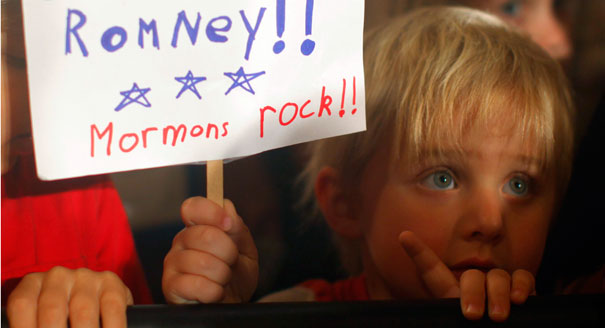
Romney's So-Called Religious Freedom


Mitt Romney said, “Freedom requires religion just as religion requires freedom. Freedom opens the windows of the soul so that man can discover his most profound beliefs and commune with God. Freedom and religion endure together, or perish alone…

“We are a nation under God, and in God we do indeed trust. We should acknowledge the Creator, as sis the founders, in ceremony and word. He should remain on our currency, in the Pledge, and in the teaching of our history.” He delivered this speech at the George Herbert Walker Bush Presidential Library, in Texas.

I wonder what the nonreligious nations of Europe would have to say about this. Especially since those nations with the less religious affiliation and influence are also happier according to their gross national happiness index. And why is it that the more religious nations tend to be less free and are less happy?


Are non-Mormons, non-Christians and non-theists still Americans under the vision Mitt Romney has for America? And what kind of America is Mitt Romney envisioning? What kind of freedom does his religion create and allow? He speaks of freedom and religious liberty, of family values and moral vision. Yet he would cut all funding for Planned Parenthood because a fraction of their public health services include providing abortions, and even when they use no public funding for those abortions. He wants to enact a federal law that would ban gay marriage. Yet this is in no way attached to his Mormon beliefs right? He speaks of “moral pollution.” He says he is “concerned with the drug culture, the pornography, the violence, sex and perversion.” He says every computer sold in the future should block all pornography. He says he wants to enforce obscenity laws. This is ironic considering that multiple studies have shown that “conservative religious type, especially Mormons, are more likely to use porn.” – Adam Greenwood (March 2, 2009).

Mitt Romney lives in his religious bubble. He will make public policy decisions based on his limited and exclusivist idea of morality and social order. It was not long ago that George Bush Sr. said, “I don’t know that atheists should be regarded as citizens, or should they be regarded as patriotic. This is one nation under God.” Those with no religious affiliation, whether atheist, non-theist or agnostic, represent 19% of the American population.  It’s time to get religion out of politics. Its time to take religion completely out of the public sphere. It’s time for nonbelievers to come out of the closet! It’s time to acknowledge and celebrate our secular heritage, our pluralistic heritage. It’s time for those with so called religious values to stop pushing their views onto other people. It’s time for a secular ethics that encourages dialog and conversation to take the place of misguided and outdated moral certainty.

http://www.patheos.com/blogs/lovejoyfeminism/2012/08/mitt-romney-will-put-an-end-to-porn-somehow.html

Thursday, September 6, 2012

Meditations for the Humanist – Part 1 – Moralism

Oscar Wilde famously said, “a man who moralizes is usually a hypocrite.” According to A. C. Grayling, a moralizer is a “person who seeks to impose upon others his [or her] view of how they should live and behave.” It reflects a coercive and exclusive worldview that is inherently opposed to democratic and pluralistic ideals.

Moralizers want others to conform to their views. They do this through coercive measures such as social disapproval as well as their more preferred option: legal controls. You can see this reflected in our nations history with blasphemy laws as well as more contemporary, hot button, issues such as gay marriage, abortion, religious symbols and text in public areas and prayer in public schools. 

Attacks on liberal policies such as these are expressions of hostility towards lifestyles moralizers personally dislike. Their hostility is brought into the public sphere, often through declarations of religious freedom, and manifest aspects of insensitivity, intolerance, ignorance of alternative interests and needs in the human experience and arrogance in believing there is only one acceptable way of living. They claim to have a “monopoly on moral judgment.’” We can recognize the familiar rhetoric of those claiming to defend the “traditionalist fantasy of ‘family morality’”. But the true attitude underneath moralizers is fear. The moralizer fears policies and practices that allow and encourage diversity in lifestyle and the freedom of choice.

Justification for their rigidly and arrogance comes from so-called religious doctrine and values. This is a pure reflection of exclusivist religion, which I’ve spoken about plenty in previous posts. This fear and its effects are inherently anti-pluralistic and anti-democratic. Diversity of thought is not allowed or encouraged. The demand conformity to lifestyles they see as personally acceptable. The external world, others, must conform to their internal preferences. Compromise is shunned and viewed as weakness. Their religious anxieties compel them to prevent the rest of society from “thinking, seeing or doing what they are afraid to think, see or do themselves.”

Secularism has become the enemy. Atheists and humanists alike are seen as being deviant and unworthy of any serious dialogue. Christianity is seen as being under attack. But secularism, in actuality, does not attack religion just like an umbrella does not attack rain. It provides a platform and foundation for diversity of thought, conscience and lifestyle. It protects all citizens’ right to have equal protection under the law, to have equal opportunity, voice and representation. Secularism encourages an ongoing, ever-evolving, creative process in public policy and societal norms. It sees culture and values as something malleable and dynamic, not fixed and rigid. And most of all, secularism, is not coercive or exclusive. All have a place at the table. Unfortunately, it also allows for the voice of the intolerant and the fearful (See “Tolerating the Intolerant” post).

Grayling, A. C. (2002). Meditation for the Humanist: Ethics for a Secular Age. Oxford: Oxford University Press. 

Thursday, July 12, 2012

Humanism 101


Bam. This is the newly updated manifesto of humanistic philosophy. A few things really stand out for me. In the opening statement, it says explicitly "without supernaturalism". This may bother some people, both religiously inclined and perhaps those who would prefer the label of spiritual. Fact of the matter is, supernaturalism has no bearing whatsoever in the collective interest of society in terms of building a cohesive and ethical system in which to live. If you disagree, please argue your case. 

Humanism aspires "to the greater good of humanity". This naturally curtains any racist, sexist or other form of discrimination based on human circumstance. Religion, as well all know, is the best at excluding others based on circumstance, whether its based on skin color, gender, sex, nationality, a different idea and symbol of the divine, or even just a different name for the same or damn near similar idea of God. The in-group/out-group dynamic has no place in humanism and it does everything in its power, from the very foundation of its ethical system, even down to its name and label, to avoid any possibility of discrimination on circumstance. 

This obviously is something we can spend a lot of time talking about and dissecting. But for newbies to humanism who constantly ask me "What's that?" or "What did you say you were?" Here is your answer. Humanism 101. 

Thursday, June 28, 2012

"Out of Many, One"

"Out of Many, One"


Do you agree with the assertion that "In God We Trust" both on our currency and as the de facto U.S. motto and that "Under God" in the Pledge of Allegiance was a 1950s fear response to communism? Was it an attempt at solidarity that happened to use federally sanctioned religious language? Or was it something else? Thoughts?

Nonetheless, it's a civic history lesson. Most people do not know that this religious language was not around until the 1950s. Using them as some sort of tangible example of our Christian or Deist religious heritage is completely unfounded. I personally like "Out of Many, One." This speaks more to the inherent pluralistic intent and reality of this country and of the world. And unlike "In God we Trust", or "Under God", it does not discriminate against nonbelievers, secularists, atheists, nontheists and the like.

Monday, June 11, 2012

American Humanist Association President David Niose


I was privileged to attend this years American Humanist Association (AHA) conference in New Orleans. During this conference the President of AHA, David Niose, gave a short talk about his new book Nonbeliever Nation: The Rise of Secular Americans. His talk was very inspirational. I would like to briefly outline some of his main points.

Niose described humanism as not just a movement, but a movement that is a response to the threat and rise of the religious right. He focused on three main themes:
1.     How the religious right has decimated this country and how many are simply unaware of how many problems are directly attributable to the religious right.
2.     Why the opposition to the religious right has been so unsuccessful and ineffective.
3.     How the modern secular movement is providing a successful opposition that if successful, could revert the religious right’s influence back to pre-Reagan levels.

Niose spoke about the infamous “culture wars” that continue to rage. Many on the religious right and even religious moderates still claim and exalt America’s rich religious heritage. They use this as a means to justify Christian predominance and influence in the public square. This, according to Niose, has created a mythology. And this mythology glosses over some terrible truths that seem to have been forgotten.

Many of our initial founders in the new world, namely pilgrims and puritans, actually despised religious pluralism and freedom. They first left England for Holland and then left Holland specifically because it was to open a society for their taste. They came to the new world in order to establish a theocracy. We seem to forget that they would hang Quakers and other Christian denominations simply because they challenged their exclusive claim to truth. And of course let us not forget the Salem Witch Trials, motivated by religious Puritanism.

Many often refer to the great religious revivals in American history. But are these revivals anything to be proud of? The apocalyptic visions they espoused still permeate our religious and unfortunately political discourse to this day (albeit more covert). And of course, they were all infused with an anti-Catholic bigotry.

Niose simply asks us to compare our religious heritage to our secular heritage. Is there anything to be ashamed of in our secular heritage? Our secular heritage was based on the values of the enlightenment. It was based on science and reason. For the first time ever, some people, in some places, under certain circumstances could actually reject Christianity openly without any repercussions. This heritage, more often than not, is never acknowledged. There is nothing in our secular history that is embarrassing, nothing we need to sweep under the rug. Rather, it is something to be proud of. Pop culture has embraced this heritage, has embraced skepticism to a degree. Yet this acknowledgement, Niose says, ends with politics. Seven states (Texas, Maryland, Tennessee, Mississippi, South Carolina, Arkansas and Pennsylvania) still ban atheists from holding public office, despite our federal constitution stipulating otherwise.

The created mythology points out that America is a Christian nation. Many often cite the reference to a “creator” in the Declaration of Independence and the legacy of the pilgrims as being evidence to this heritage. Yet these arguments fail to mention that this was before our nation was actually founded. This was in the colonial era. Our nation was formed by our constitution, which not only has no mention of God or any higher power, but also goes no further than to start saying “We the people…” That is all the authority the required. Those on the religious right also love to be in denial of the famous Treaty of Tripoli that explicitly states, “As the government of the United States of America is not in any sense founded on the Christian religion…” This treaty passed unanimously and there were ZERO vocal objections to its passing. Many state governments, at our nations inception, did have state recognized religions. However, after the constitution was passed and came into effect, every state within two decades disestablished those religions. Our nation, I’m happy to say, is not a Christian nation. It is a secular nation. In this way it puts all faiths, including those with no faith, as being equal before the law.

Non-Christians now make up around 25% of our total population, more than ever in our history. No public official espouses humanism, or secularism openly. Instead they try and prove to everyone that they are also religious! Nonbelievers will even downplay their non-belief! This not only validates religion but also equates religion with morality. Atheism has become a bad word. It has become a term linked to immorality.

Humanism espouses a belief that human beings can solve human problems without any divine intervention, direction or blessing. Humanism and the religious right are engaged in a battle, a battle for the very consciousness of America. What this boils down to is identity and identity politics. Secular identity can no longer be secondary as it has been in previous generations. It must become primary! Especially if it is to be the one effective force we have against the growing power and influence of the religious right in our politics. The minds of Americans need to be changed so that discrimination against non-believers must end and the religious right can finally be challenged.

Thursday, April 12, 2012

Karen Armstrong and The Case for God


Karen Armstrong, in her book, The Case for God, doesn’t do what you think she does. Armstrong is a religious academic and historian, and a damn good one at that. She is a religious apologist, but not for the kind of religion most of us think of when we think of religion. She has just as many criticisms with religion as most atheists do including, I would say, people like Richard Dawkins and Sam Harris. Where they differ however is their scope in what they mean by religion in the first place. Most people’s ideas about religion are highly reductionist. Questions like “Do you believe in God”, or “Are you a Christian”, are usually easily understood and answered accordingly through common connotations and cultural assumption. Religion and God usually mean very clear things, whether is the Evangelical version or the Mormon version, there is a level of certainty in making these claims and assumptions. As we’ll see many atheists and Armstrong could not agree more in their criticism about this sort of religion. However, most atheists stop here and limit their criticism of religion to this narrow arena of understanding and praxis.


Generally speaking, mystics, yes even Christian mystics, and many eastern traditions embrace relative amounts of uncertainty and not knowing. Religion and God are understood as being metaphorical labels and symbols for that which cannot be known and cannot be spoken about by limited human minds, languages and imaginations. They speak of religion and God in a completely different way, that in Armstrong’s view is more true and authentic. Armstrong says that what religion truly is and can be is fundamentally at odds with the majority of its worldly manifestations that cling to certainty and dogma. In her view, some religion is better than others depending on the level of embrace of not-knowing. Again, here she will agree with many atheists. I will present some of her amazing ideas, then offer some of my own, including criticisms of her work.

Armstrong begins by differentiating mythos and logos. Mythos was first designed “to help people to navigate the obscure regions of the psyche, which are difficult to access but which profoundly influence our thought and behavior” (xi). Myths were not effective if people simply believed in them, they were programs of action. Religion was based around mythos. It was not something people thought but what hey did. Truth was acquired through practical action influenced by and motivated by mythos.

Religion however, went corrupt when logos began to overtake mythos. Myth was discredited and the scientific method took its place as the only reliable means of attaining truth. After this revolution, religious knowledge became theoretical rather than practical. Belief suddenly became a fundamental axiom and prerequisite of faith. Because of this transition, today we speak of believers and unbelievers as if accepting some amount of dogma is an essential activity (xv). In Armstrong’s view, this is a gross distortion of what religion is. Many of us have been “left stranded with an incoherent concept of god” (320).


We have forgotten to value unknowing. It is important to “recognize the limits of our knowledge, silence, reticence, and awe” (xviii). Religious practice must naturally entail what she calls ‘esktasis’, which can be described as a stepping outside the norm, “stepping outside the prism of ego and experience the sacred” (xiii). It necessarily involved uncertainty. This unknowing was celebrated and delighted in. In transcending the ego through religious practice, for example, we experience sadness directly, “it not longer become my sadness but sorrow itself” (xiv).

The sacred, or God, is transcendent. In the vain of Tillich and Heidegger, this is what is called the Ground of Being. The eternal Tao is the Tao that cannot be named. The Tao has no qualities, no form. It can be experienced but never seen, it is not a god. It predates heaven and earth. It is beyond divinity, neither being nor nonbeing. As Armstrong summed up, “it [is] impossible to define or describe, because Being is all encompassing and our minds are only equipped to deal with particular beings, which can merely participate in it in a restricted manner” (11). This ground is a power that is higher, deeper and more fundamental than our notions of god or gods. It transcends our limited personalities. In every religious tradition, there is a “deliberate and principled reticence about god and/or the sacred” (xviii).

Being itself, is not only the ground of being, it is also the ground of the human psyche. It is neither external nor alien to humanity. The two are connected. This is the microcosm and macrocosm, the atman and Brahman. This is how we are able to experience it…we are it! Human beings are wired to yearn for transcendent experiences, to yearn for esktasis. In this way, Armstrong argues that religion, as it should be practiced and understood will never disappear. It is a defining aspect of humanity. She says, “the desire to cultivate a sense of the transcendent may be the defining human characteristic” (9).

For Armstrong, this lasted until the rise of modernity, the rise of logos at the expense of mythos. “Before the modern period, most men and women were naturally inclined to religion and they were prepared to work at it” (10). Before modernism, people were not expected to believe in the abstract. Humanity forgot that “authentic religious discourse could not lead to clear, distinct and empirically verified truth” (21). Religion is not something provided to the masses by authority figures, it was not a notional activity. Accepting dogma on someone else’s authority completely abdicates personal responsibility. Religion did not require belief in a set of doctrines. She says, “Religious discourse should not attempt to impart clear information about the divine but should lead to an appreciation of the limits of language and understanding…it could not be accessed by rational, discursive thought but required a carefully cultivated state of mind and the abnegation of selflessness” (26). Faith was a matter of practical insight and active commitment, it had little to do with abstract belief. For example, the Buddha had little time for theological speculation and metaphysical questions. What difference would it make to discover that a god had created the world? “Pain, hatred, grief and sorrow would still exist. These issues were irrelevant” (23).

For Armstrong, modernity brought a lust for certainty. This certainty made religion more logos based at the expense of a more transcendent, unknowning based religion, which is more authentic and transformative and real. For someone who has much criticism for the reductionism of religion, she is being highly reductionist in her view of modernism. Modernism can be said in part to be a response to the tyranny and oppressive authority of religion. Nonetheless, she elevates the religion of the past and says what we see today is a distortion of a truth lost in translation.

Secularism for Armstrong has a large negative effect. She does not see it as the fulfillment of the rational ethos of the enlightenment. Secularism in her view is creating a violent and oppressive religious backlash. She says a militant religiosity, will “emerge in every region where a secular, western style government had separated religion and politics” (292-3). Fundamentalists feel under threat, they are defensive and are unwilling to entertain rival points of view be they other religions, or social issues such as evolution, homosexuality, feminism and abortion. Secularism did not create these fundamentalists. They are reacting to it.

Using her model, Armstrong critiques most atheists quite well. She says,
“Atheism is parasitically dependent on the form of theism it seeks to eliminate and becomes its reverse mirror image…all three [Sam Harris, Christopher Hitchens and Richard Dawkins) insist that fundamentalism constitutes the essence and core of all religion” (xvi). This may be true. However, Armstrong takes her views much further. She says, “Dawkins is not correct to assume that fundamentalist belief either represents or is even typical of either Christianity or religion as a whole…he is mistaken to assume that this is the way people have generally understood the term God (304)…Christian fundamentalists are convinced that their doctrinal beliefs are an accurate, final expression of sacred truth and that every word of the Bible is literally true – an attitude that is a radical departure from mainstream Christian tradition (294)” Does this woman live under a rock or something? Anywhere from 33% to 62% of Americans think the Bible is the literal truth of God. I know that’s quite a spectrum, but best-case scenario is 33%. That’s one third of Americans! And that is no small demographic! Refer to previous blog posts about the prominence of fundamentalist religion in the world.

I do agree with Armstrong when she says “this type of religiosity represents a retreat from god” (295). In this way, she completely agrees with atheists. She says the holy trinity (Harris, Hitchens and Dawkins) present religion at its absolute worst (306), which is also true. However, she continues saying that they are not “theologically literate,” and are intellectually conservative. “They never discuss the work of such theologians as Bultmann or Tillich who offer a very different view of religion and is closer to mainstream religion than any fundamentalist” (307). While this is also true she is false to make the assumption that notknowing religion is closer to the mainstream than fundamentalist religion. She downplays its manifestation, its influence and its power and thus undervalues the atheist and secular agendas. Atheism, for her, is just another divisive theology. She does not see its importance in the overall debate concerning sacredness. After all, what can be more sacred than a rational and well thought out critique of religion and its superstitions and dogmas?

She says the “atheist assault is likely to drive the fundamentalists to even greater commitment to creationism, and their contemptuous dismissal of Islam is a gift to Muslim extremists, who can use it to argue that the West is indeed intent on a new crusade” (308). This may also be true but it does not mean that atheism should be abandoned or discredited!

Arstrong’s conclusions and calls for action are hard to disagree with however. We do indeed need to shed a great deal of our knowledge about religion so that we can move on to new insights. Where she and I disagree is that atheism and secularism is a necessary player in this process. Faith and belief, she says, have become unfortunately fused in modern consciousness (305). Belief now exclusively means an intellectual submission to a “somewhat dubious position.” What it means to be religious or to believe in God no longer means what it used to. We are stuck in certainty. She says, “to make limited historical phenomena – a particular idea of god, creation science, family values, Islam or the holy land – more important than the sacred reverence due to the ‘other’ is a sacrilegious denial of everything that god stands for” (322). However, there is an innate desire for ekstasis, for mythos. Armstrong thinks we are entering a post-secular age. She hopes that atheist and theist alike should abandon the modern appetite for certainty. “No state of affairs is permanent, and we are now witnessing the death of the death of god.” She calls for a “negative theology”, namely a theology based in unknowing. We should drive our reasoning power to the point where we can go no further, and in this moment, we should not be frustrated but should experience a sense of “astonishment, awe and contentment.” We can turn within and become aware of otherness. Religion should be transformative with a marked effect on the personality. There is no dramatic “born-again” experience defined by intense certainty, but is a slow, incremental and imperceptible transformation.

I will return to Armstrong more when I begin discussing Ken Wilber. Most particularly, his idea of the pre/post fallacy.

Sunday, April 8, 2012

William Cavanaugh - The Myth of Religious Violence


In his book, The Myth of Religious Violence, Cavanaugh attempts to address false assumptions about the dichotomy of religion and secularism, particularly in how they are perceived in accordance with violence. The myth of violence he says is “the idea that religion is a transhistorical and transcultural feature of human life, essentially distinct from secular features such as politics and economics, which has a peculiarly dangerous inclination to promote violence.” Religion, because of this dangerous inclination, must therefore be tamed by restricting its access to public power. The secular nation-state will then appear a natural result, responding to the inherent dangers of religion. First, I’ll outline a few of Cavanaugh’s points and then add some brief responses.


Throughout history it can be extremely difficult to separate religion from political life. Indeed, the very beginnings of nation-states were built on exclusionary principles based around religious belief and identity. Political and economic motivations can be inextricable intertwined with religious ideology and worldview. Portraying religion as being inherently dangerous and irrational, Cavanaugh says, is used by the secular state to justify its own forms of violence. He says, any attempt to separate religious violence from secular violence is fundamentally incoherent. The enlightenment narrative invented this assumed dichotomy between the religious and the secular. That religion is dangerous and irrational it must therefore give way to more rational, secular forms of power. In other words, in creating this vision of irrational and dangerous religion, an ‘other’ was established that legitimates coercive measures against that ‘other.’

Cavanaugh says that he is not set out to argue that religion either does or does not promote violence, but rather to analyze the political conditions under which the very category of religion is constructed. And this category has been constructed as violent, irrational and fanatical. He argues that so called secular ideologies and institutions like nationalism and liberalism can be just as absolutist, divisive, and irrational as those called religious. Claims about the violence of religion are centered on the assumption that religion is theoretically separate from secular realities like politics and economics. The myth of violence, therefore obscures the pursuits of the state. The nation-state has become a new kind of religion, appropriating the holy from religion itself to justify its own purposes. In the context of international affairs and foreign policy we can see how this plays out. If religion has a peculiar tendency to promote violence then societies that have learned to tame religious passions in public are seen as superior and more inherently peaceable that societies which have not. Policy follows suit.

Cavanaugh’s theories are in service to this vision: “In constructing artificial distinctions between religious and secular violence, types of violence and exclusion labeled secular have escaped full moral scrutiny. In doing away with the myth of religious violence, we are not, of course, thereby licensed to create new blind spots, to ignore or excuse anti secular violence [i.e. religious violence] as justifiable. We must restore the full and complete picture of violence in our world, to level the playing field so that violence of all kinds is subject to the same scrutiny. Violence”, he says, “feeds on the need for enemies, the need to separate us from them. Such binary ways of dividing the world make the world understandable for us but they also make the world unlivable for many. Doing away with the myth of religious violence is one way of resisting such binaries and, perhaps, turning enemies into friends” (230). This vision is laudable and noteworthy regardless of its validity. However, I have many, many criticisms of his ideas. A few of which I’ll describe here:

Cavanaugh’s stance is in defense of religion. He seems to adopt a radical defensiveness that the religious right seems to adopt for itself. Their tradition, their way of life, their beliefs are under attack by the liberal media, by the government itself. This completely denies the reality of how powerful religion is a force in public life. Yes, prayer is not allowed in public schools, yes abortion is somewhat legal but these are not closed issues, the debate rages on with intense vigor from the religious majority. The term “under God” is in our national anthem, “In God We Trust” is on our currency, the 10 commandments and other religious displays are present on public property like courthouses. Again, these are not closed issues. But the point I am making is that the religious voice in this country is not oppressed. A liberal, secular majority that sees them as being fanatical and dangerous is not controlling them. If that were the case, the powerful religious presence in the Republican party would be nonexistent.

Cavanaugh also uses a reductionist view of religion. The idea that religion is a label created, through the enlightenment, by the secular state, in contrast to secularism is absurd. Religion serves many more functions that those as defined in its contrast to secularism. This however will be a point I elaborate on much further when I discuss Ken Wilber. For now, lets say that his use of the term religion lacks depth.

Cavanaugh claims also do not invalidate the fact that religion is, or can be, absolutist, divisive and irrational. And as such, it warrants a certain response to these tendencies that are indeed rational! Furthermore, he seems to equate all forms of violence; that all forms should be subject to the same quantity and quality of scrutiny. While this sounds great it denies the fact that not all kinds of violence are equally dangerous. Religious violence is simply more dangerous because it is irrational and has no empirical basis for its claims. While secular violence must have a certain level of rational justification for its actions. This quality alone differentiates these two forms of violence. Nation-states do not serve the same functions as religion. To equate the two is just silly. However similar they may be in creating in-groups and out-groups and providing meaning through ideology and symbols, they do not make any claims for absolute truth, build churches, provide a system of beliefs and practices for salvation or repentance or provide supernatural meaning. In this way, Cavanaugh’s claim that secularism is a new religion is absurd and inaccurate.

However, the myth of religious violence, the idea that the dichotomy of the religious and the secular, may causes us to ignore or deny secular forms of imperialism and violence and it warrants our attention. However, it should not be used in a way to justify or defend or invalidate religious violence as a primary concern for human life and international affairs. Religious violence is real and problematic and “doing away” with the myth of religious violence will not bring to light secular forms of violence any more than a variety of other means would, such as politics, activism international law and humanitarian networks.

Nonetheless, it is a great book with a truly revolutionary contribution to the field of politics, religion and international affairs.