Monday, September 10, 2012

Romney's So-Called Religious Freedom


Mitt Romney said, “Freedom requires religion just as religion requires freedom. Freedom opens the windows of the soul so that man can discover his most profound beliefs and commune with God. Freedom and religion endure together, or perish alone…

“We are a nation under God, and in God we do indeed trust. We should acknowledge the Creator, as sis the founders, in ceremony and word. He should remain on our currency, in the Pledge, and in the teaching of our history.” He delivered this speech at the George Herbert Walker Bush Presidential Library, in Texas.

I wonder what the nonreligious nations of Europe would have to say about this. Especially since those nations with the less religious affiliation and influence are also happier according to their gross national happiness index. And why is it that the more religious nations tend to be less free and are less happy?
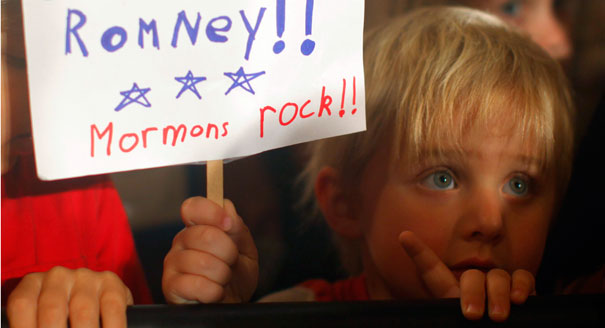

Are non-Mormons, non-Christians and non-theists still Americans under the vision Mitt Romney has for America? And what kind of America is Mitt Romney envisioning? What kind of freedom does his religion create and allow? He speaks of freedom and religious liberty, of family values and moral vision. Yet he would cut all funding for Planned Parenthood because a fraction of their public health services include providing abortions, and even when they use no public funding for those abortions. He wants to enact a federal law that would ban gay marriage. Yet this is in no way attached to his Mormon beliefs right? He speaks of “moral pollution.” He says he is “concerned with the drug culture, the pornography, the violence, sex and perversion.” He says every computer sold in the future should block all pornography. He says he wants to enforce obscenity laws. This is ironic considering that multiple studies have shown that “conservative religious type, especially Mormons, are more likely to use porn.” – Adam Greenwood (March 2, 2009).

Mitt Romney lives in his religious bubble. He will make public policy decisions based on his limited and exclusivist idea of morality and social order. It was not long ago that George Bush Sr. said, “I don’t know that atheists should be regarded as citizens, or should they be regarded as patriotic. This is one nation under God.” Those with no religious affiliation, whether atheist, non-theist or agnostic, represent 19% of the American population.  It’s time to get religion out of politics. Its time to take religion completely out of the public sphere. It’s time for nonbelievers to come out of the closet! It’s time to acknowledge and celebrate our secular heritage, our pluralistic heritage. It’s time for those with so called religious values to stop pushing their views onto other people. It’s time for a secular ethics that encourages dialog and conversation to take the place of misguided and outdated moral certainty.

http://www.patheos.com/blogs/lovejoyfeminism/2012/08/mitt-romney-will-put-an-end-to-porn-somehow.html

Friday, September 7, 2012

Agnostic Buddhism - Buddhism Without Beliefs


Stephen Batchelor, in his book Buddhism Without Beliefs, describes an agnostic Buddhism. He does not describe Buddhism as a religion per se but as a method. Buddhism, he says, is not so much something to believe in, but is something to do. It is an activity, a lifestyle and a practice that we can integrate into every aspect of our experience. To be a Buddhist, do you have to be someone who believes certain propositions such as the four noble truths or reincarnation? According to Batchelor, the answer is no. He says Buddhism is not particularly religious or spiritual in the usual ways we understand these terms. It is simply a way to be in the world. Rather than being focused on deities, beliefs and supernatural claims, Batchelor claims Buddhism is founded in the agnostic tradition.

T.H. Huxley first coined agnosticism in 1869. He explained it as a method “realized through the ‘rigorous application of a single principle.’” This principle has both positive and negative aspects. The positive aspect exclaims, “Follow your reason as far as it will take you.” The negative aspect asserts that one should “not pretend that conclusions are certain which are not demonstrated or demonstrable. “ An agnostic Buddhist would not regard Buddhism as a source of answers to questions of where we came from, where we are going or what happens after death. Batchelor says an agnostic Buddhist would seek knowledge in the appropriate domains such as science. As for supernatural claims and questions about the origin of the universe or what happens after death, the Buddha himself remained silent. These questions were seen as distractions, as irrelevant to our human condition, irrelevant to the reality of suffering.

Buddhism however can become a dogmatic system when we elevate the matter of fact-ness of the four noble truths to holiness. They can become propositions to believe in. (Western scholars even superimposed the term Buddhism. This label allowed Buddhism to become a creed, which could be then compared to other creeds around the world. It can be easy to reduce a tradition and a religion such as Buddhism to a list of beliefs and practices that obscures its agnostic heritage and complexity.) Supernatural questions are seen as mysteries, not problems with answers that can be solved through meditation or prayer or through belief in a set of doctrine. Arbitrary answers to supernatural questions that are not demonstrated or demonstrable are simply irrelevant.  Strategies such as prayer and beliefs in doctrine merely replace mystery with beliefs in an answer that are often clinged to with such fervor that they distract from true ethical conversation and can even cause a great deal suffering, hatred and divisiveness.

Batchelor makes an important distinction between existential confrontation and existential consolation. Most of what we understand as religion can be seen as consisting of condolatory elements such as assurances of a better afterlife. Buddhist practice can be said to start not with belief in a transcendent reality but through embracing the “anguish experience in an uncertain world.” This is the essence of the first noble truth. We must have the courage to face whatever life throws at us without recourse to supernatural claims or consolations. To accept whatever comes with equanimity, and the humility to learn from every situation. Agnosticism shifts concern away from the future life and supernatural dialogue and brings it back to the present moment. Agnosticism is not passive. Instead, it is a dialogue, an ongoing encounter and existential confrontation with the unknown and mystery of our existence. Buddhism in this way, Batchelor says, might have “more in common with godless secularism than with the bastions of [western] religion.”

We must also make a distinction between ethics and morals, or more specifically ethical integrity as being distinct from moral certainty. A priori certainty about right and wrong is simply at odds with a changing and unreliable world. An ethical question should not be framed as ‘what is the right thing to do?” but “what is the compassionate thing to do?” This question can be approached with integrity but not with certainty. Likewise, agnostic Buddhism demands ethical conversation rather than moral claims based in supernatural hope and fear. This dialogue inevitably forces an encounter with our moral conditioning, which is based largely in psychological and social habit. We tend repeat the gestures of parents, authority figures, or religious texts. And while this sort of moral conditioning may arguably contribute to some aspect of social stability, it is nonetheless inadequate as a paradigm of ethical integrity. Encountering our socialized norms of morality, ethics, and supernatural claims and assumptions is precisely the type of encounter that agnosticism and Buddhism seek out. It is a creative and ongoing process that can be said to be the very basis of a genuine religious lifestyle, of genuine ethical conversation, both as individuals and collectively. Moral certainty based in supernatural claims that are not demonstrated or demonstrable, also inevitably lead to fantasies of moral superiority. As Batchelor said, “Instead of creatively participating in a contemporary culture of awakening, we confine ourselves to preserving those cultures of a vanishing past…we repeat the clichés and dogmas of other epochs.” We have seen many times how fantasies of moral certainty do not foster compassion or ethical dialogue, but usually result in arrogant, elitist and confrontational perspectives.

Our definition of religion itself is being challenged and expanded. Publishers Weekly, in reviewing Batchelor’s book said, “Buddhism is not strictly a religion, since it does not adhere to a belief in God; that the Buddha did not consider himself a mystic or savior, but a healer; and that Buddhism is less a ‘belief system’ than a personal ‘course of action’ that naturally instills morality, compassion, and inner peace in the practitioner.” The problem with this quote however is that it equates religion with theism and having a belief system. Buddhism is better said to be a nontheistic religion. After all, a tradition can be a religion even if it does not believe in a God or gods or have supernatural beliefs. Buddhism instead, can be thought of as a method. It is continuously evolving and adapting to the needs of the human condition without recourse to supernatural claims and without belief in a god or deities. Agnostic Buddhism is at its core, a confrontation and dialogue with our human condition. For further elaboration on the definition and understanding of evolving religion, see my previous post on Ken Wilber. 

Batchelor, Stephen. (2008). Buddhism Withouth Beliefs: A Contemporary Guide to Awakening. Riverhead Trade.

Thursday, September 6, 2012

Meditations for the Humanist – Part 1 – Moralism

Oscar Wilde famously said, “a man who moralizes is usually a hypocrite.” According to A. C. Grayling, a moralizer is a “person who seeks to impose upon others his [or her] view of how they should live and behave.” It reflects a coercive and exclusive worldview that is inherently opposed to democratic and pluralistic ideals.

Moralizers want others to conform to their views. They do this through coercive measures such as social disapproval as well as their more preferred option: legal controls. You can see this reflected in our nations history with blasphemy laws as well as more contemporary, hot button, issues such as gay marriage, abortion, religious symbols and text in public areas and prayer in public schools. 

Attacks on liberal policies such as these are expressions of hostility towards lifestyles moralizers personally dislike. Their hostility is brought into the public sphere, often through declarations of religious freedom, and manifest aspects of insensitivity, intolerance, ignorance of alternative interests and needs in the human experience and arrogance in believing there is only one acceptable way of living. They claim to have a “monopoly on moral judgment.’” We can recognize the familiar rhetoric of those claiming to defend the “traditionalist fantasy of ‘family morality’”. But the true attitude underneath moralizers is fear. The moralizer fears policies and practices that allow and encourage diversity in lifestyle and the freedom of choice.

Justification for their rigidly and arrogance comes from so-called religious doctrine and values. This is a pure reflection of exclusivist religion, which I’ve spoken about plenty in previous posts. This fear and its effects are inherently anti-pluralistic and anti-democratic. Diversity of thought is not allowed or encouraged. The demand conformity to lifestyles they see as personally acceptable. The external world, others, must conform to their internal preferences. Compromise is shunned and viewed as weakness. Their religious anxieties compel them to prevent the rest of society from “thinking, seeing or doing what they are afraid to think, see or do themselves.”

Secularism has become the enemy. Atheists and humanists alike are seen as being deviant and unworthy of any serious dialogue. Christianity is seen as being under attack. But secularism, in actuality, does not attack religion just like an umbrella does not attack rain. It provides a platform and foundation for diversity of thought, conscience and lifestyle. It protects all citizens’ right to have equal protection under the law, to have equal opportunity, voice and representation. Secularism encourages an ongoing, ever-evolving, creative process in public policy and societal norms. It sees culture and values as something malleable and dynamic, not fixed and rigid. And most of all, secularism, is not coercive or exclusive. All have a place at the table. Unfortunately, it also allows for the voice of the intolerant and the fearful (See “Tolerating the Intolerant” post).

Grayling, A. C. (2002). Meditation for the Humanist: Ethics for a Secular Age. Oxford: Oxford University Press. 

Friday, August 24, 2012

How Islamist Are They?

I recently read an article called "How Islamist Are They?" in the Christian Science Monitor Weekly about the emerging constitutions in Egypt, Libya and Tunisia. It was written by Kristen Chick and John Thorne for the August 20-27 Edition. Here is a summary of their article:

Egypt, Tunisia and Libya are all in transition, writing new constitutions. All three countries are coming out of dictatorships that more often than not oppressed Muslims. These new constitutions will usher in a new era that will answer many questions about the role Islam will play in the governance of these countries, and for the region as a whole. Many are watching with a close eye to how these new governance structures will deal with civil rights, women’s rights and free speech. 

Balancing tradition Muslim values and western culture is not going to be an easy task in any of these countries. While in Tunisia, western culture may be more prominent due to their French roots, even those who call for an absence of Islam in their constitutions shy away from the term secular as it connotes a godlessness that is not easily embraced anywhere in the region. Many call for a strict interpretation of sharia and would seek to impose restrictions on a wide variety of behaviors such as drinking alcohol in public, outlawing offense to religion and gender segregation. Others call for a more liberal undertaking. Sharia not only means “Islamic Law” but is also a guide for personal life and behavior. There are many different interpretations on what it means and calls for, let alone how it should be incorporated into law and policy. So when groups say they will use it as a basis for lawmaking, it is difficult to say exactly what this means.

Tunisia:

The moderate Islamist party that leads the coalition government has explicitly stated that it will not cite sharia in its new constitution. This party, called Al Nahda, took 89 of 217 seats in parliament. The coalition government is power-sharing government, with two other non-Islamist parties. While Tunisia, in comparison to both Egypt and Libya seems to exhibit a more mild approach to the incorporation of Sharia into governance, there are still calls for its influence. For example, Al Nahda proposed a law that would “criminalize any offense toward core elements of Abrahamic faiths including God, the prophet Muhammed, and holy books.”
There have been several riots the past few years centered on art and films that were deemed blasphemous. Free speech is a new commodity in Tunisia. After five decades of religiously oppressive dictatorship, many are worried that a religiously driven government will erode this newly enjoyed enterprise of free speech.

Egypt:

There are two main parties in Egypt, the Muslim Brotherhood’s Freedom and Justice Party (FJP) and the Nour Party. Nour came in second in the elections and was formed by the Salafis, the most conservative of Egypt’s Muslims. They call for similar policies to those of Saudi Arabia, such as strict gender segregation. The Nour Party has also called for harsh punishments such as chopping off the hands of thieves, and the banning of alcohol. However, there have been other, more liberal, proposals such as an attempt to make it easier for women to divorce. The FJP won nearly half of all parliament seats and are calling for a slow, gradual increase of the influence of Islam in society and in governance. FJP member Muhammed Morsi won the presidency and he has repeatedly stated he will implement sharia. The FJP even said that women and Christians couldn’t hold the office of president. They have also called for the creation of a council of clerics that will interpret whether or not a given law conforms to sharia. But which version of sharia is the question, and that will remain to be seen. Egypt, however, is the likely candidate for the nation that will have the most influence of Islam in government.

Libya:

Following suit with Egypt, Libya has agreed that, “sharia should be the basis for lawmaking.” However, despite their conservative leanings, the National Forces Coalition won the majority of votes in July’s elections. They have rejected both Islamist and secular labels and call for “problem solving over ideology.” Nonetheless, having Islam inform lawmaking is still considered natural. Chick and Thorne say, “The question is not whether to apply Islam in governance, but how.” Those who desire for Islam to be kept out of politics altogether are certainly the minority.

In all three countries, these new constitutions will open a dialog that will give the people the ability to experiment and evolve a governance structure of their own. We will eagerly keep watch and see how this pans out.


Tuesday, July 24, 2012

"In God We Teach"

The newly released documentary “In God We Teach” follows the story of Mattew LaClair, a high school student in Kearney, New Jersey. LaClair brought forth allegations of his high school history teacher, David Paszkiewicz preaching Christianity in the classroom. This documentary examines this case and its underpinning issues in just over an hour. I highly recommend you watch the entire film. However, if you would like to skip around and see just the highlights if have a few key moments referenced.

21:50 - 23:00: Paszkiewicz likens Christianity to having the cure for cancer. If you have the truth, why would you keep it from other people?

26:00: Paszkiewicz says, "there are a lot of lost people out there. If they are unreached, the consequences could be terrible"

29:00: Is the younger generation as aware as older generations of issues around separation of church and state?

31:30 - 34:00: Academic freedom is discussed.

34:42: Paszkiewicz says, "Teaching Darwinism is something thats going to take poeple's eyes off of God, especially Jesus Christ."

37:30: Paszkiewicz says, "and it may be against the law to teach creationism as fact but that doesn't mean its wrong."

In addition to being a youth pastor, Paszkiewicz also leads Christian Club Meetings for youth. At these meetings he attempts to disprove evolution and the big bang. This is something that has always rubbed me the wrong way. Regardless of my personal opinions about religion and its constant denial and suppression of science in fundamentalist followings, religion and science, especially religion and evolution are not mutually exclusive. There are certain folks, that would like to be seen as representative of religion, who draw this distinction. They do not represent religion, and they certainly are not representative of Christianity as a whole. That being said, evolution is not, and should not be associated with atheism. It is nontheistic. It is science. Nothing more. If this disproves any aspect of religious thought, then that religious thought must adapt, change or be destroyed. It is no longer representative of our current knowledge about the world and our relationship to it.

42:15: Paszkiewicz says, "I don't believe that my religious beliefs trump the constitution but I do believe that the word of god does."

42:00 - 44:00: Paszkiewicz says, "Religious neutrality is one thing but hostility to Christianity is quite another, and what I find is that this neutrality often means the exclusion from Christianity in the public square."

There is to often the argument that there is a war against Christianity in this country, or a war against Christmas. This is all complete nonsense. If the government does not support a certain view of Christianity or any religion, it is automatically seen as being hostile to that view/religion. The government is a secular institution. It is meant to be free of competing religious ideas as these are the most virulent competitions.

46:00: Paszkiewicz says, "We take god out of the equation, in time, i fear what kind of government we could have."

46:30: Paszkiewicz says, "I do think we ought to be unified around a set of values that are essentially Judeo-Christian"

48:00: Paszkiewicz "I don't see the danger in promoting, lets say the 10 commandments, how can things like 'thou shalt not kill' be psychologically damaging to a student?"

It is so easy for a supporter of the ten commandments to cite the “thou shalt not kill’ commandment as evidence that all ten should be accepted and taught. It neglects to mention the majority of the other nine. Why is this? Maybe its because “thou shalt have no other gods before me” or “do not take the lords name in vain” or “on the seventh day the lord rested” have absolutely no place in civil society, let alone its governance.

A year after this incident Paszkiewicz formed a student “Alpha and Omega Club.” This club was planning a trip to the creation museum in Kentucky. The “educational rationale,” for the trip was that: "students will be exposed to the science behind creationism."

This is a great documentary. I highly recommend it. If anything else it’s a great introduction into the multifaceted debate on the separation of church and state, prayer and other religious ceremonies or ideas in public schools, the so-called evolutionism/creationism debate and the growth of the nonbeliever population in the United States and what its effect could be on combating the religious right and the organization of “nones” as a political demographic. The link for the documentary is here: http://ht.ly/cndug 

Thursday, July 12, 2012

Humanism 101


Bam. This is the newly updated manifesto of humanistic philosophy. A few things really stand out for me. In the opening statement, it says explicitly "without supernaturalism". This may bother some people, both religiously inclined and perhaps those who would prefer the label of spiritual. Fact of the matter is, supernaturalism has no bearing whatsoever in the collective interest of society in terms of building a cohesive and ethical system in which to live. If you disagree, please argue your case. 

Humanism aspires "to the greater good of humanity". This naturally curtains any racist, sexist or other form of discrimination based on human circumstance. Religion, as well all know, is the best at excluding others based on circumstance, whether its based on skin color, gender, sex, nationality, a different idea and symbol of the divine, or even just a different name for the same or damn near similar idea of God. The in-group/out-group dynamic has no place in humanism and it does everything in its power, from the very foundation of its ethical system, even down to its name and label, to avoid any possibility of discrimination on circumstance. 

This obviously is something we can spend a lot of time talking about and dissecting. But for newbies to humanism who constantly ask me "What's that?" or "What did you say you were?" Here is your answer. Humanism 101. 

Wednesday, July 4, 2012

Evolving Support for Marijuana Legalization

There is obvious growing support for Marijuana legalization. There is an even larger support base in general disapproval of the drug war. Federal legalization of marijuana is just one answer and possible solution to the many ills of marijuana's inclusion in the war in drugs. Decriminalization is another often spoken of solution. Currently, only thirteen states have enacted decriminalization laws for the non-medical use of marijuana: California, Alaska, Connecticut, New York, Maine, Massachusetts, North Carolina, Mississippi, Ohio, Minnesota, Nebraska, Colorado and Oregon. 


In this next graph we can see support of marijuana legalization by demographic and political affiliation.

This graph shows an amazing trend. The more liberal you are, the more likely you are to support marijuana legalization. You are also more likely to support legalization if you are younger, are a democrat, moderate or an independent. Generally speaking, if you identify as a Republican or a conservative, the more likely you are to oppose legalization. You are also more likely to oppose if you live in the Souther and Midwestern regions of the country. And of course, you are more likely to oppose legalization the older you are.

Does this trend sound at all familiar? In my mind it also correlates strongly with levels of religiosity. The older you are, if you live in the South or Midwest, if you identify as a Republican or a conservative, the higher chance you are of being religious. Likewise, the younger you are, the more liberal or democratically inclined you are, if you live in the Western or Eastern U.S., the more likely you are to identify as nonreligious. Broad generalizations yes, but the evidence is clear.

My question then is this: Do levels of religiosity directly correlate to ones perspective on marijuana in its legality and morality? If so, why is this correlation present? Why would the religiously minded be opposed to using marijuana for recreational or religious/spiritual purposes? The answer I hope will become clearer in later posts. But these graphs certainly are interesting.