Wednesday, October 24, 2012

UN Peacekeeping: Rwanda 1994


Prior to the 1994 genocide, Rwanda has had ethnic power struggles for some time, between the Tutsi minority (who occupied a privileged position in the colonial administration before independence) and the Hutu majority. The former Tutsi dominance of the colonial era gave way to Hutu dominance through a violent power struggle following independence from Belgium in 1962. After independence many remained fearful of a Tutsi return to power. 

In 1990 the predominantly Tutsi Rwandese Patriotic Front (RPF) launched an assault from Uganda against the Hutu dominated government of President Juvenal Habyarimana. In February 1993, the RPF launched its largest offensive and came within 15 miles of Kigali, the Rwandan capital city. Under pressure from France, Belgium and the US, the RPF and the Rwandan government entered negotiations to end the conflict. This resulted in the Arusha Accords, signed in August of 1993. The accords established a power sharing democratic government that represented both sides and a unified army composed of both sides. As part of this agreement, a neutral UN force was to be deployed to uphold the deal.

Although there was much resistance to sending a peacekeeping force to Rwanda, the UN Assistance Mission in Rwanda was created (UNAMIR). The vote to approve UNAMIR happened just days after the Somalian catastrophe. The US was insistent on rejecting any situation that might put their troops in a potentially forceful situation. Domestically, the US also had an agenda for reducing the budget for UN peacekeeping missions. In 1994, the US rejected a proposed peacekeeping contingency fund that would allow for the US to provide emergency financing for rapid peacekeeping efforts. The US was becoming more and more isolationist in its foreign policy altogether. They still owed around “$900 million in unpaid contributions to the regular UN budget and its peacekeeping expenses” (50). Congress had “refused to approve [these contributions] despite the legal obligation as a UN member state” (50). However, this is another topic that I’ll hopefully write about in another post. As a result, the US first argued to send only 100 troops for UNAMIR. 8,000 were requested, with a 5,000 troop minimum requirement. The US sent 2,500.

The international community was somewhat ignorant of Rwanda and its history. There was awareness of a history of ethnic conflict and also in neighboring Burundi. However, UNAMIR was cast off with an air of optimism. It seemed like much safer ground than Somalia. However, the UN troop deployment got off to a rocky start. By December 1993, it was clear that the forces were “totally inadequate.” No troop contributing country had been willing to supply a self-contained 800-man infantry battalion. This was considered an essential force for the capital city of Kigali. Instead two battalions were given, one from Belgium consisting of 398 men and the other from Bangladesh consisting of 370 men (of which only 266 arrived). UNAMIR was meant to have 22 armored personnel carriers and eight helicopters yet no country was willing to provide them, which meant a lack of deterrent capability, and a reserve mobile force. Engineers and logisticians were reassigned as infantry due to this lack. The carrier vehicles that were provided were completely “dilapidated”, and only five were serviceable. They often broke down and had to be towed by other carriers. This was an embarrassment. The potential for a disaster started to become much clearer and fear grew of a repeat of Somalia but with a considerably smaller military presence, and without “any possibility of reinforcement” (53).

Romeo Dallaire, the force commander of UNAMIR, in January of 1994 wrote to the DPKO detailing the growing crisis. Later in April, from his car, he witnessed two Belgian peacekeeping troops being held and beaten. He could do nothing but negotiate. He said, “I just can’t get those guys out of there. I just don’t have the forces.” In response, the DPKO told Dallaire to pressure President Habyarimana, that if violence did occur that the Security Council would take action. This was meant to convey the impression that powerful nations could bring serious repercussions upon Rwanda.

In April 1994, a plane with President Habyarimana and President Cyprien Ntaryamire of Burundi was shot down. Everyone was killed. The Hutu government initiated violence. They blamed the RPF and the Tutsis for the attack. The following day, the ten Belgian troops assigned to protect the Prime Minister of Rwanda were captured. They were ordered to lay down their weapons and not engage in combat by their commander Luc Marchal. The prime minister was then assassinated and the troops murdered and mutilated. Massacres began to spread beyond the capitol. Civilians were being killed in the open by government troops, militias and bands of Hutu civilians.

Any collapse on the Arusha Accords would result in the termination of UNAMIR, and the Rwandan government knew this. Shortly after the violence began, a senior Rwandan official spoke of a plan to kill the Belgian peacekeepers. He said, “We watch CNN too, you know,” This was referring to the Somalian crisis. He knew that if UN troops were attacked and killed, the troop-contributing countries would pull the rest of their forces out. He was correct. Five days later the Belgian government pulled its troops out of Rwanda. This was the core fighting force of UNAMIR. It effectively gutted UNAMIR of any clout. By April 27th 1994, the Security Council voted to bring the UNAMIR force down to only 270 troops. There was simply no interest in becoming involved. Bob Dole effectively portrayed this perspective saying, “I don’t think we have any national interest here. I hope we don’t get involved…the Americans (US citizens in Rwanda) are out. As far as I’m concerned, in Rwanda that ought to be the end of it” (58).

Secretary General Boutros-Ghali pushed for a major military intervention but it was unanimously rejected. The Security Council took no responsibility for the worsening situation in Rwanda and continuously denied the fact that it was genocide. At this point an estimated 200,000 people had been killed. 250,000 more people had escaped into Tanzania, the largest mass exodus of refugees ever witnessed by the UN. Eventually, on May 17th, the council reestablished UNAMIR calling it UNAMIR II and called for a force of 5,500. However, once again, no one was willing to provide these troops. Annan said,
At DPKO, we spent endless days frantically lobbying more than a hundred governments around the world for troops. I called dozens myself, and the responses were all the same. We did not receive a single serious offer. It was one of the most shocking and deeply formative experiences of my entire career, laying bare the disjuncture between the public statement of alarm and concern for the suffering of other people on the one hand, and, on the other, the unwillingness to commit any of the necessary resources to take action. The world knew the scale of the killing in Rwanda, and yet we could not get anyone, from governments across the world, to do anything serious to help (59).

The genocide eventually ended due to the victory of the RPF. They overthrew the government in July but not before 800,000 Tutsi and moderate Hutu’s had been murdered. 800,000 people were killed in Rwanda in 100 days. A new government was established, and after this, troops were finally sent to UNAMIR II, well after the genocide and civil war was over. The lesson here, Annan says, is that the genocide and protection of citizens could have happened if there was the military capacity and political will. However, in 1994 “there was simply no culture or precedent in the international system of UN intervention in an internal conflict to use military force decisively to protect citizens” (59). Combined with the impact of Somalia, the result was inaction. 

Monday, October 22, 2012

UN Peacekeeping: Somalia 1993


Introduction:
I am beginning to read Kofi Annan’s new book Interventions: A Life in War and Peace. I don’t know very much about the history of the United Nation or its evolution of purpose and scope since its inception after WW2. This book provides a thorough account of major world events including human rights issues and abuses, civil wars, peacekeeping, global governance, the millennium development goals and terrorism. As I read this book, I’ll be posting little summaries of interesting information particularly, the history and facts of certain events that I believe most of us, myself included, have a limited and narrow understanding.

In my studies at DU in International Human Rights, I did not focus on human rights issues through the lens of major international conflicts or civil wars in the developing world. I also did not focus on genocide of which DU has many classes and expertise.  In my undergrad work (Contemplative Psychology and Religious Studies), I also did not have the opportunity, outside of my lack of personal initiative, to learn a lot about international affairs and various humanitarian conflict-type situations. From this vantage point, I view this book as an incredible learning tool to make up for this lack. Most of us I think, myself included, have either an idealistic, pessimistic, reductionist or naive understanding of how the UN operates in regard to peacekeeping and responses to conflicts around the world. Having the facts of what actually happened from the perspective of the former UN secretary general is invaluable.

Annan begins his book by describing the complex world of UN peacekeeping, especially in the context of civil wars. He focuses on three examples that he refers to as the United Nation’s “toughest-ever crises – and greatest of failures” (32): the 1993 Somalia crisis, the genocide in Rwanda in 1994 and the massacre in Srebenic, Bosnia in 1995. I want to briefly go over his testimony of these events. Hopefully, they will not only provide historical knowledge but also elucidate the inherent complications of peacekeeping and global governance.

Background Context:
In between WW2 and the 1980s, there were only a handful of UN peacekeeping missions. Before 1988 there were only a dozen, but between 1988 and 1992, another ten were created. This is due in part to the Cold War. In its early years, the five permanent members of the Security Council (Russia, China, the UK, France and the US) were not able to contribute troops to peacekeeping efforts mainly due to the potential for escalating Cold War rivalry. After 1988 and the beginning of the end of the Cold War, the Security Council was able to agree more often without this kind of confrontation. There were many peacekeeping successes during this time including monitoring ceasefires between Iraq and Iran, the political transition in Nicaragua and the withdrawl of Cuban troops from Angola. Most notable however was Operation Desert Storm in response to the Iraqi invasion of Kuwait in 1990. The response was a UN-authorized, US-led coalition. Almost a million men and women were deployed from 34 countries.

This new era of peacekeeping however also led to the alteration of its principles. Codified in 1973, the formal rules of peacekeeping were as follows:

· Peacekeeping troops could only be deployed only with the consent of the parties to the dispute.
· Peacekeeping had to be strictly impartial in their deployment and activities.
· Peacekeepers could use force only in self-defense.
· Peacekeepers should be mandated and supported by the Security Council in their activities.
· Peacekeeping operations had to rely on the voluntary contributions of member states for military personnel, equipment, and logistics.

The then Secretary General Boutros-Ghali was commissioned to present a document on how the UN might operate in the transforming geopolitical climate. He created a document called An Agenda for Peace. In this document he focused on the rising civil war conflicts around the world and how they demanded a new level of international intervention. He also proposed that due to the nature of these types of conflict, the deployment of UN peacekeeping forces should no longer require consent from all parties. This change presented a new level of risk for peacekeeping forces. Force was now something to be more prepared for. Troop contributing forces had to accept this new level of risk as well as higher levels of political will and commitment. However, these risks and commitments were largely unrecognized as it was hard to foresee how these conflicts and peacekeeping missions would play out.

The UN peacekeeping governing structure is highly complicated. Firstly, you have the Security Council, which has the power to form a UN field operation and is “responsible for determining its mandate, objectives, and parameters” (36). Second, the UN Secretariat, which is the administrative body of the UN, manages operation logistics and day-to-day practicalities. Thirdly, the troop contributing countries retain authority over the forces they deploy. This creates a bureaucratic nightmare. Decision-making is fragmented and the communication and coordination between governing bodies can be difficult. Reform of this system was never pushed for because none of the peacekeeping missions up to this point had displayed its flaws in a serious way. Troop contributing countries also benefited from the existing structure. For instance, the deployment of troops in peacekeeping efforts carries their foreign policy humanitarian ambitions and the deployment of troops allows one to take responsibility for responding to crises. However they are able to abdicate a certain amount of responsibility by simultaneously deploying troops without proper acknowledgement of the inherent risk.

Case One: Somalia
In 1991, Somali President Barre fell out of power and his void gave way to an intense power struggle between interim president Ali Mahdi Mohamed and the chairman of the United Somali Congress, General Mohamed Farrah Aidid. Power structures eventually gave way to multiple armed factions and competing gangs that created a series of mini-wars. The Somali civilian population suffered greatly from these conflicts and the UN presence was not capable of dealing them. A great famine was created not just due to environmental reasons but also due to the armed forces consciously obstructing aid from reaching the population. Annan said, “services and systems of trade and food distribution disappeared as the months rolled past” (39). A large portion of the population suffered from malnutrition. “1.5 million were considered at immediate risk of death.” Delivering humanitarian aid was simply not enough. At the transition from 1991 to 1992, some agreements were reached culminating in a ceasefire in March of 1992. As part of this deal the UN Operation in Somalia was created (UNOSOM). This operation was created to oversee the ceasefire and to accompany humanitarian aid around the country.

Despite the ceasefire, in August of 1992, eleven Red Cross workers were killed in Kismayo (a southern port city). 250 tons of food was stolen from the ports. Gangs and looters were blocking food trucks in Mogadishu. People, including children, were dying of malnutrition even at UN feeding centers. It was becoming clear that the political resolution was not taking hold. The capabilities of the UN mission were “inadequate.” All efforts to increase aid were met with responding efforts to disrupt their access to the population. Food warehouses were full while “an estimated 3,000 Somalis were dying every day, with perhaps 300,000 already dead” (42).

Boutros-Ghali recommended that the use of force was “the only feasible option.” The Security Council then unanimously adopted a measure (UNOSOM II) that established any means to secure an “environment for humanitarian relief operation in Somalia” (42). The US, under George H. W. Bush, sent 28,000 troops and twenty other countries collectively provided another 17,000. This force however was thought to be in Somalia for a short period of time. It was there merely to “prepare the way for a return to peacekeeping and post conflict peacebuilding. (42). Initiatlly this mission was very successful. Humanitarian supplies were being delivered to 40% of the country. The troops were being pulled out even as the fighting continued.

With a much smaller troop presence and a more fragmented command structure, a mandate was given to begin disarming the competing factions within Somalia. This force was never above 20,000 troops. This mandate presented many problems. For example, any faction targeted for disarming would find itself in a disadvantaged position against its rivals. No Somali warlord was about to let this happen. Following a series of small incidents, 25 Pakistani soldiers were killed and fifty other wounded. General Aidid was blamed. Attention quickly shifted away from the broader picture of peacekeeping, peacebuilding and disarmament to focus on capturing this one man. This focus was the straw that broke the camels back and ultimately crippled the UN mission in Somalia and sent the country into years of chaos. Boutros-Ghali sent a separate force of US troops specifically to hunt General Aidid. This chain of command was independent of the UN mission and was done so without the knowledge of existing UN troops in Somalia. The attempt to capture General Aidid failed horribly and resulted in “two helicopters being shot down, 18 US soldiers killed, and scores of others wounded” (45). Images were screened around the world of dead US soldiers stripped naked and dragged through Mogadishu streets.

This level of causalities was not anticipated and in response, there was a call for an immediate end to US involvement. This gutted the UN mission, taking its best-trained and best-equipped soldiers away from a worsening situation. The rest of the troops from other nations, being now more vulnerable, followed suit and pulled out of Somalia. As Annan said, “Thus ended the greatest experiment ever attempted to use peace enforcement in a mission motivated by humanitarian goals” (45). Somalia was abandoned and the population was punished by perpetual civil chaos and suffering. The world saw fit to ignore Somalia until it was recognized that international terrorists began to emerge there years later.

This failure brought into clear view the “dysfunctional nature of the peacekeeping system” (46). President Bill Clinton even said after this mission that the US would never again put troops in harms way in a UN peacekeeping mission. There grew an international aversion to taking risks. Nonetheless, more peacekeeping missions were deployed in more civil wars around the world. Unfortunately the very first operation to occur after this failure in Somalia and in this new UN climate was the Rwandan genocide in 1994. I will post about Rwanda and Bosnia in a separate post.

Tuesday, September 11, 2012

Meditations for the Humanist - Part 2 - Tolerance and DOMA


“The peak of tolerance is most readily achieved by those who are not burdened with convictions.” – Alexander Chase

An intolerant person is defined as one who “wishes others to live as the thinks they ought, and who seeks to impose his practices and beliefs upon them” (Grayling 2002, 7) True tolerance states that humanity thrives most by “permitting a variety of lifestyles to flourish, because they represent experiments from which might be learned about how to deal with the human condition” (Grayling 2002, 7-8).  Democracy has a similar aim in that a government run by the people, for the people, must include the voices and active participation of all demographics for it to flourish, especially if it is to afford the protect of minority rights. There is an inherent danger in democratic style government, namely majority oppression of minorities.

Grayling says,
Tolerance is, however, not only the centerpiece but the paradox of liberalism. For liberalism enjoins tolerance of opposing viewpoints, and allows them to have their say, leaving it to the democracy of ideas to decide which shall prevail. The result is to often the death of toleration itself, because those who live by hard principles and uncompromising views in political, moral and religious respects always, if given half a chance, silence liberals because liberalism, by its nature, threatens the hegemony they wish to impose.
Foreseeing this danger, the founders blessed us with the Bill of Rights as well as checks and balances in government. This was done in order to protect all citizens, especially minority demographics from majority oppression, including religious oppression.

The traditional republican platform has always had a foundation in states rights and a smaller federal government. The power of the federal government was seen as a threat to personal liberty.  However, when it comes to civil liberties and human rights issues, puritan morality seems to trump this age-old Republican value. This is becoming quite relevant with various contemporary social issues, especially homosexuality, marriage and the DOMA (Defense of Marriage Act). 

Traditionally marriage has been a religious ceremony, and many prefer it to remain as such. However, in this country, in this secular country, marriage is a civil right. Vermont, Connecticut and New York, which all have legalized gay marriage, now content that DOMA is a violation of states rights. They contend that the federal government has not right or authority to regulate the institution of marriage. The civil rights granted by marriage simple have nothing to do with religion, such as social security benefits, child-care tax credits, family and medical leave to take care of loved ones and COBRA health care for spouses and children. By denying a citizen these civil rights, they are thereby being denied human rights. The fourteenth Amendment to the Constitutions provides all citizens equal protection under the law. The Universal Declaration of Human Rights also speaks to this issue in its first, second and seventh articles, which says “All are equal before the law and are entitled without any discrimination to equal protection of the law…”

DOMA is designed to prevent the legalization of same-sex marriage at the state level. The LGBTQ community is being discriminated against as they are denied this equal protection. They are being denied their civil/human rights. Once more, they are being denied this right from the Republican Party that supposedly champions personal freedom and liberty and views the Federal government as intrusive and oppressive. This is a fabulous example of how the Republican platform has lost its way. It is no longer centered around small government and states rights, but it has been hijacked by moralistic, intolerant religious fanatics who at their very core are opposed to the liberalism, pluralism and democratic ideals that America is founded upon.

I am not saying that marriage cannot be a religious ceremony. What I am saying is that in a democratic, pluralistic society, those who do not wish to be religious, those who do not want religion to have any part of their civil/human rights, shouldn’t be denied their rights because it makes religious people uncomfortable.

By providing the same rights to all citizens, society will thrive and become more cohesive and functional. Chris Kluwe, the punter for the Minnesota Vikings said, “You know what having these rights will make gays? Full-fledged American citizens just like everyone else, with the freedom to pursue happiness and all that entails. Do the civil-rights struggles of the past 200 years mean absolutely nothing…?” Chuck Norris recently said a thousand years of darkness will not ensue. And many prominent figures who claim that hurricanes and other natural disasters are Gods punishment for sanctioning equality are intolerant religious bigots who should not be tolerated, let alone be given a platform to spew their fear. Intolerance itself is merely a symptom of fear and insecurity. And this is what the Republican Party has become in my eyes, a political party based on intolerance rooted in fear and insecurity. The relevant question is….”Should the tolerant tolerate the intolerant?” And the answer is obviously no. Tolerance must protect itself. No one can force another to adopt a certain viewpoint or practice. The only coercion should be argument and honest reasoning, which is what we would expect from our government. Religious freedom does not entail the right to discriminate. Protecting minorities and civil rights is not an attack on Christianity. It is compassionate. It is based in identification with all of humanity, regardless of creed, sex, color of skin and any other label. It is based in ethics, an ethics encouraged not by religious discourse, but by secular discourse, which provides and equal footing for all. For a deeper in depth discussion please see my previous post “Tolerating the Intolerant.”

http://www.npr.org/blogs/thetwo-way/2012/09/09/160840674/states-rights-and-doma-clash-on-a-shifting-battlefield?ft=1&f=1001

Grayling, A.C. (2002). Meditations for the Humanist: Ethics for a Secular Age. Oxford: Oxford University Press.

Monday, September 10, 2012

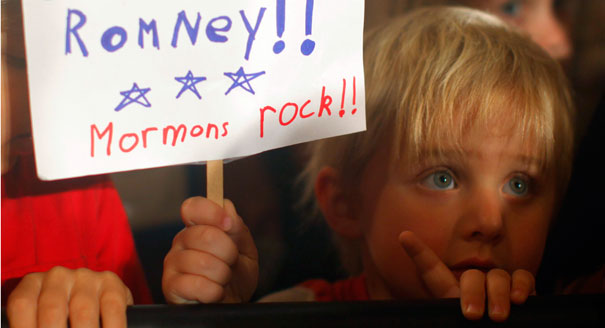
Romney's So-Called Religious Freedom


Mitt Romney said, “Freedom requires religion just as religion requires freedom. Freedom opens the windows of the soul so that man can discover his most profound beliefs and commune with God. Freedom and religion endure together, or perish alone…

“We are a nation under God, and in God we do indeed trust. We should acknowledge the Creator, as sis the founders, in ceremony and word. He should remain on our currency, in the Pledge, and in the teaching of our history.” He delivered this speech at the George Herbert Walker Bush Presidential Library, in Texas.

I wonder what the nonreligious nations of Europe would have to say about this. Especially since those nations with the less religious affiliation and influence are also happier according to their gross national happiness index. And why is it that the more religious nations tend to be less free and are less happy?


Are non-Mormons, non-Christians and non-theists still Americans under the vision Mitt Romney has for America? And what kind of America is Mitt Romney envisioning? What kind of freedom does his religion create and allow? He speaks of freedom and religious liberty, of family values and moral vision. Yet he would cut all funding for Planned Parenthood because a fraction of their public health services include providing abortions, and even when they use no public funding for those abortions. He wants to enact a federal law that would ban gay marriage. Yet this is in no way attached to his Mormon beliefs right? He speaks of “moral pollution.” He says he is “concerned with the drug culture, the pornography, the violence, sex and perversion.” He says every computer sold in the future should block all pornography. He says he wants to enforce obscenity laws. This is ironic considering that multiple studies have shown that “conservative religious type, especially Mormons, are more likely to use porn.” – Adam Greenwood (March 2, 2009).

Mitt Romney lives in his religious bubble. He will make public policy decisions based on his limited and exclusivist idea of morality and social order. It was not long ago that George Bush Sr. said, “I don’t know that atheists should be regarded as citizens, or should they be regarded as patriotic. This is one nation under God.” Those with no religious affiliation, whether atheist, non-theist or agnostic, represent 19% of the American population.  It’s time to get religion out of politics. Its time to take religion completely out of the public sphere. It’s time for nonbelievers to come out of the closet! It’s time to acknowledge and celebrate our secular heritage, our pluralistic heritage. It’s time for those with so called religious values to stop pushing their views onto other people. It’s time for a secular ethics that encourages dialog and conversation to take the place of misguided and outdated moral certainty.

http://www.patheos.com/blogs/lovejoyfeminism/2012/08/mitt-romney-will-put-an-end-to-porn-somehow.html

Friday, September 7, 2012

Agnostic Buddhism - Buddhism Without Beliefs


Stephen Batchelor, in his book Buddhism Without Beliefs, describes an agnostic Buddhism. He does not describe Buddhism as a religion per se but as a method. Buddhism, he says, is not so much something to believe in, but is something to do. It is an activity, a lifestyle and a practice that we can integrate into every aspect of our experience. To be a Buddhist, do you have to be someone who believes certain propositions such as the four noble truths or reincarnation? According to Batchelor, the answer is no. He says Buddhism is not particularly religious or spiritual in the usual ways we understand these terms. It is simply a way to be in the world. Rather than being focused on deities, beliefs and supernatural claims, Batchelor claims Buddhism is founded in the agnostic tradition.

T.H. Huxley first coined agnosticism in 1869. He explained it as a method “realized through the ‘rigorous application of a single principle.’” This principle has both positive and negative aspects. The positive aspect exclaims, “Follow your reason as far as it will take you.” The negative aspect asserts that one should “not pretend that conclusions are certain which are not demonstrated or demonstrable. “ An agnostic Buddhist would not regard Buddhism as a source of answers to questions of where we came from, where we are going or what happens after death. Batchelor says an agnostic Buddhist would seek knowledge in the appropriate domains such as science. As for supernatural claims and questions about the origin of the universe or what happens after death, the Buddha himself remained silent. These questions were seen as distractions, as irrelevant to our human condition, irrelevant to the reality of suffering.

Buddhism however can become a dogmatic system when we elevate the matter of fact-ness of the four noble truths to holiness. They can become propositions to believe in. (Western scholars even superimposed the term Buddhism. This label allowed Buddhism to become a creed, which could be then compared to other creeds around the world. It can be easy to reduce a tradition and a religion such as Buddhism to a list of beliefs and practices that obscures its agnostic heritage and complexity.) Supernatural questions are seen as mysteries, not problems with answers that can be solved through meditation or prayer or through belief in a set of doctrine. Arbitrary answers to supernatural questions that are not demonstrated or demonstrable are simply irrelevant.  Strategies such as prayer and beliefs in doctrine merely replace mystery with beliefs in an answer that are often clinged to with such fervor that they distract from true ethical conversation and can even cause a great deal suffering, hatred and divisiveness.

Batchelor makes an important distinction between existential confrontation and existential consolation. Most of what we understand as religion can be seen as consisting of condolatory elements such as assurances of a better afterlife. Buddhist practice can be said to start not with belief in a transcendent reality but through embracing the “anguish experience in an uncertain world.” This is the essence of the first noble truth. We must have the courage to face whatever life throws at us without recourse to supernatural claims or consolations. To accept whatever comes with equanimity, and the humility to learn from every situation. Agnosticism shifts concern away from the future life and supernatural dialogue and brings it back to the present moment. Agnosticism is not passive. Instead, it is a dialogue, an ongoing encounter and existential confrontation with the unknown and mystery of our existence. Buddhism in this way, Batchelor says, might have “more in common with godless secularism than with the bastions of [western] religion.”

We must also make a distinction between ethics and morals, or more specifically ethical integrity as being distinct from moral certainty. A priori certainty about right and wrong is simply at odds with a changing and unreliable world. An ethical question should not be framed as ‘what is the right thing to do?” but “what is the compassionate thing to do?” This question can be approached with integrity but not with certainty. Likewise, agnostic Buddhism demands ethical conversation rather than moral claims based in supernatural hope and fear. This dialogue inevitably forces an encounter with our moral conditioning, which is based largely in psychological and social habit. We tend repeat the gestures of parents, authority figures, or religious texts. And while this sort of moral conditioning may arguably contribute to some aspect of social stability, it is nonetheless inadequate as a paradigm of ethical integrity. Encountering our socialized norms of morality, ethics, and supernatural claims and assumptions is precisely the type of encounter that agnosticism and Buddhism seek out. It is a creative and ongoing process that can be said to be the very basis of a genuine religious lifestyle, of genuine ethical conversation, both as individuals and collectively. Moral certainty based in supernatural claims that are not demonstrated or demonstrable, also inevitably lead to fantasies of moral superiority. As Batchelor said, “Instead of creatively participating in a contemporary culture of awakening, we confine ourselves to preserving those cultures of a vanishing past…we repeat the clichés and dogmas of other epochs.” We have seen many times how fantasies of moral certainty do not foster compassion or ethical dialogue, but usually result in arrogant, elitist and confrontational perspectives.

Our definition of religion itself is being challenged and expanded. Publishers Weekly, in reviewing Batchelor’s book said, “Buddhism is not strictly a religion, since it does not adhere to a belief in God; that the Buddha did not consider himself a mystic or savior, but a healer; and that Buddhism is less a ‘belief system’ than a personal ‘course of action’ that naturally instills morality, compassion, and inner peace in the practitioner.” The problem with this quote however is that it equates religion with theism and having a belief system. Buddhism is better said to be a nontheistic religion. After all, a tradition can be a religion even if it does not believe in a God or gods or have supernatural beliefs. Buddhism instead, can be thought of as a method. It is continuously evolving and adapting to the needs of the human condition without recourse to supernatural claims and without belief in a god or deities. Agnostic Buddhism is at its core, a confrontation and dialogue with our human condition. For further elaboration on the definition and understanding of evolving religion, see my previous post on Ken Wilber. 

Batchelor, Stephen. (2008). Buddhism Withouth Beliefs: A Contemporary Guide to Awakening. Riverhead Trade.

Thursday, September 6, 2012

Meditations for the Humanist – Part 1 – Moralism

Oscar Wilde famously said, “a man who moralizes is usually a hypocrite.” According to A. C. Grayling, a moralizer is a “person who seeks to impose upon others his [or her] view of how they should live and behave.” It reflects a coercive and exclusive worldview that is inherently opposed to democratic and pluralistic ideals.

Moralizers want others to conform to their views. They do this through coercive measures such as social disapproval as well as their more preferred option: legal controls. You can see this reflected in our nations history with blasphemy laws as well as more contemporary, hot button, issues such as gay marriage, abortion, religious symbols and text in public areas and prayer in public schools. 

Attacks on liberal policies such as these are expressions of hostility towards lifestyles moralizers personally dislike. Their hostility is brought into the public sphere, often through declarations of religious freedom, and manifest aspects of insensitivity, intolerance, ignorance of alternative interests and needs in the human experience and arrogance in believing there is only one acceptable way of living. They claim to have a “monopoly on moral judgment.’” We can recognize the familiar rhetoric of those claiming to defend the “traditionalist fantasy of ‘family morality’”. But the true attitude underneath moralizers is fear. The moralizer fears policies and practices that allow and encourage diversity in lifestyle and the freedom of choice.

Justification for their rigidly and arrogance comes from so-called religious doctrine and values. This is a pure reflection of exclusivist religion, which I’ve spoken about plenty in previous posts. This fear and its effects are inherently anti-pluralistic and anti-democratic. Diversity of thought is not allowed or encouraged. The demand conformity to lifestyles they see as personally acceptable. The external world, others, must conform to their internal preferences. Compromise is shunned and viewed as weakness. Their religious anxieties compel them to prevent the rest of society from “thinking, seeing or doing what they are afraid to think, see or do themselves.”

Secularism has become the enemy. Atheists and humanists alike are seen as being deviant and unworthy of any serious dialogue. Christianity is seen as being under attack. But secularism, in actuality, does not attack religion just like an umbrella does not attack rain. It provides a platform and foundation for diversity of thought, conscience and lifestyle. It protects all citizens’ right to have equal protection under the law, to have equal opportunity, voice and representation. Secularism encourages an ongoing, ever-evolving, creative process in public policy and societal norms. It sees culture and values as something malleable and dynamic, not fixed and rigid. And most of all, secularism, is not coercive or exclusive. All have a place at the table. Unfortunately, it also allows for the voice of the intolerant and the fearful (See “Tolerating the Intolerant” post).

Grayling, A. C. (2002). Meditation for the Humanist: Ethics for a Secular Age. Oxford: Oxford University Press. 

Friday, August 24, 2012

How Islamist Are They?

I recently read an article called "How Islamist Are They?" in the Christian Science Monitor Weekly about the emerging constitutions in Egypt, Libya and Tunisia. It was written by Kristen Chick and John Thorne for the August 20-27 Edition. Here is a summary of their article:

Egypt, Tunisia and Libya are all in transition, writing new constitutions. All three countries are coming out of dictatorships that more often than not oppressed Muslims. These new constitutions will usher in a new era that will answer many questions about the role Islam will play in the governance of these countries, and for the region as a whole. Many are watching with a close eye to how these new governance structures will deal with civil rights, women’s rights and free speech. 

Balancing tradition Muslim values and western culture is not going to be an easy task in any of these countries. While in Tunisia, western culture may be more prominent due to their French roots, even those who call for an absence of Islam in their constitutions shy away from the term secular as it connotes a godlessness that is not easily embraced anywhere in the region. Many call for a strict interpretation of sharia and would seek to impose restrictions on a wide variety of behaviors such as drinking alcohol in public, outlawing offense to religion and gender segregation. Others call for a more liberal undertaking. Sharia not only means “Islamic Law” but is also a guide for personal life and behavior. There are many different interpretations on what it means and calls for, let alone how it should be incorporated into law and policy. So when groups say they will use it as a basis for lawmaking, it is difficult to say exactly what this means.

Tunisia:

The moderate Islamist party that leads the coalition government has explicitly stated that it will not cite sharia in its new constitution. This party, called Al Nahda, took 89 of 217 seats in parliament. The coalition government is power-sharing government, with two other non-Islamist parties. While Tunisia, in comparison to both Egypt and Libya seems to exhibit a more mild approach to the incorporation of Sharia into governance, there are still calls for its influence. For example, Al Nahda proposed a law that would “criminalize any offense toward core elements of Abrahamic faiths including God, the prophet Muhammed, and holy books.”
There have been several riots the past few years centered on art and films that were deemed blasphemous. Free speech is a new commodity in Tunisia. After five decades of religiously oppressive dictatorship, many are worried that a religiously driven government will erode this newly enjoyed enterprise of free speech.

Egypt:

There are two main parties in Egypt, the Muslim Brotherhood’s Freedom and Justice Party (FJP) and the Nour Party. Nour came in second in the elections and was formed by the Salafis, the most conservative of Egypt’s Muslims. They call for similar policies to those of Saudi Arabia, such as strict gender segregation. The Nour Party has also called for harsh punishments such as chopping off the hands of thieves, and the banning of alcohol. However, there have been other, more liberal, proposals such as an attempt to make it easier for women to divorce. The FJP won nearly half of all parliament seats and are calling for a slow, gradual increase of the influence of Islam in society and in governance. FJP member Muhammed Morsi won the presidency and he has repeatedly stated he will implement sharia. The FJP even said that women and Christians couldn’t hold the office of president. They have also called for the creation of a council of clerics that will interpret whether or not a given law conforms to sharia. But which version of sharia is the question, and that will remain to be seen. Egypt, however, is the likely candidate for the nation that will have the most influence of Islam in government.

Libya:

Following suit with Egypt, Libya has agreed that, “sharia should be the basis for lawmaking.” However, despite their conservative leanings, the National Forces Coalition won the majority of votes in July’s elections. They have rejected both Islamist and secular labels and call for “problem solving over ideology.” Nonetheless, having Islam inform lawmaking is still considered natural. Chick and Thorne say, “The question is not whether to apply Islam in governance, but how.” Those who desire for Islam to be kept out of politics altogether are certainly the minority.

In all three countries, these new constitutions will open a dialog that will give the people the ability to experiment and evolve a governance structure of their own. We will eagerly keep watch and see how this pans out.